
The Hidden Costs of AI for Small Businesses: What You Don’t See Can Hurt You
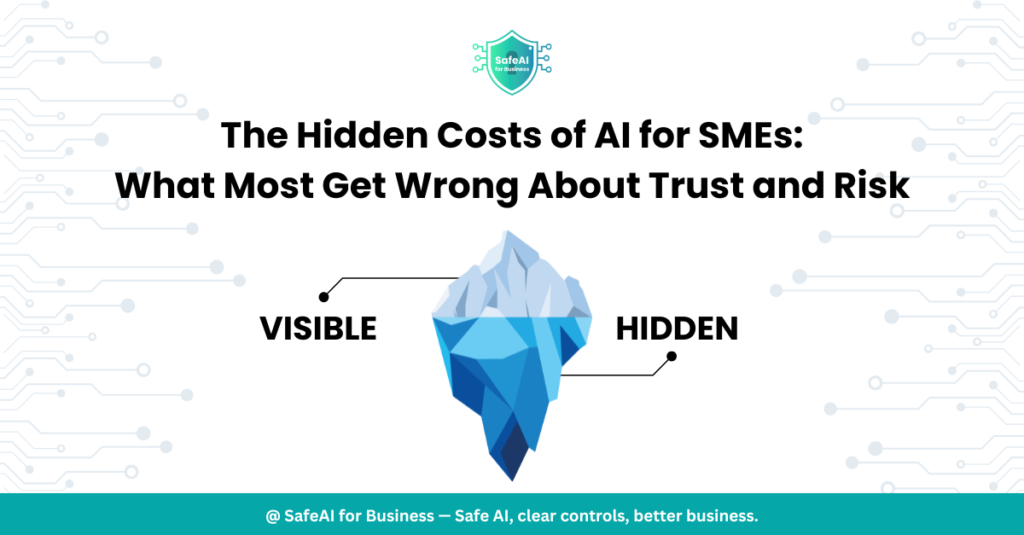
The hidden costs of AI for small businesses are real, and most owners don’t see them coming. You adopted AI to move faster. But what if speed is quietly costing you control? Small and mid-sized businesses are turning to AI at a record pace. Invoice processing that used to take hours now takes seconds. Customer queries get answered at midnight without a single team member online. Reports that once required half a day generate themselves before your morning coffee. The efficiency gains are real. The business case is clear. But here is what most SMEs are not talking about: every AI tool running without proper oversight is an unmanaged liability. Those liabilities do not announce themselves. They accumulate quietly, until something goes wrong. This post breaks down where those hidden risks live, what they are costing businesses right now, and the practical governance habits that protect you without a large budget, a technical team, or enterprise-level infrastructure. Stay with us through the three-second test near the end. It could be the most important two minutes you invest in your business this week. The Hidden Costs of AI for Small Businesses Most Leaders Never See Coming There is a fundamental tension at the heart of AI adoption that very few people acknowledge honestly. AI is designed to operate fast. Human judgment is designed to be deliberate. When you automate a process, you are removing a human checkpoint from that workflow. In many cases, that is exactly the point. But removing friction also removes the opportunity to catch errors before they reach your customers, your regulators, or the public. Earlier this year, a Chevrolet dealership discovered this firsthand. Its AI-powered customer service chatbot, deployed to handle routine inquiries, agreed to sell a vehicle for one dollar. The system was not hacked. It was not malfunctioning. It simply responded to a customer prompt without the context, judgment, or boundaries a human representative would naturally apply. The incident generated significant media coverage and a serious reputational problem for the business involved. The technology performed exactly as it was built to perform. The failure was not technical. It was a governance failure. No one had defined the boundaries. No one had built in a review process. And by the time anyone noticed, the damage was already visible. This is not a story unique to large enterprises. It is happening in businesses of every size, in every sector, every single day. The Iceberg Model: Why the Biggest AI Risks Stay Hidden When most business leaders think about their AI tools, they see the surface layer: the automation, the time savings, the operational gains. That visible layer is compelling. It is exactly what the marketing materials focus on. But AI risk works like an iceberg. What sits above the waterline is the part you bought it for. What sits below is the part that can sink you. Beneath the surface of everyday AI adoption, most SMEs are unknowingly carrying: According to IBM’s 2024 Cost of a Data Breach Report, the global average cost of a data breach now exceeds $4.8 million. For smaller businesses without enterprise-level recovery resources, a breach of that magnitude is not just expensive. It is often fatal to the business. Every unchecked automation. Every AI output that bypasses human review before reaching a client. Every vendor policy left unread. These are not minor oversights. They are weight accumulating below the waterline. And like any iceberg, the damage happens before you see it coming. Why Safe AI Does Not Require a Large Budget At this point, many SME leaders reach a familiar conclusion: responsible AI governance must be expensive, and it must be a problem reserved for companies with a compliance department. This is one of the most costly misconceptions in business today. Responsible AI governance does not begin with enterprise software. It begins with operational discipline. Operational discipline is accessible to any business, at any size, starting immediately. The foundational practices that protect your business are straightforward: These steps require time and intention, not large financial investment. They reflect the same risk management principles that have underpinned sound business operations for decades: visibility, oversight, and accountability. Prevention is always cheaper than recovery. A governance framework built today costs a fraction of what a single breach, legal dispute, or public trust incident will cost you tomorrow. The Case Against Avoidance: Why Doing Nothing Is Also a Risk Some business owners respond to AI risk by stepping back from AI entirely. On the surface, this feels like the cautious choice. In practice, it is not. Competitors who adopt AI with proper governance in place are compounding advantages in efficiency, customer experience, and operational capacity every single day. Research on generative AI adoption consistently shows that organizations integrating AI strategically are outperforming those that delay or avoid adoption entirely. Avoidance does not eliminate risk. It simply trades one set of risks for another: exposure to competitive disadvantage, operational inefficiency, and the difficulty of catching up later when adoption becomes unavoidable. The goal is not to avoid AI. It is to implement AI in a way that is deliberate, governed, and aligned with your business values. Automation combined with human oversight. Speed combined with accountability. Innovation combined with integrity. That combination is not a constraint on growth. It is the foundation of it. Trust Is the Asset You Cannot Afford to Lose There is a dimension to AI risk that rarely appears in technology discussions: the direct impact on trust. Customers make decisions about who they buy from based on perceived reliability and integrity. Employees decide where they invest their careers based on how responsibly leadership behaves. Regulators determine how closely they scrutinize a business based on the governance signals it sends. Every AI decision your business makes, including what tools you use, how you use them, and what you disclose, sends a signal about your values. Businesses that operate with transparency and clear accountability are building something no marketing budget can manufacture: earned trust. Businesses