AI for Business

AI risk management checklist for small businesses
AI for Business, Practical Guidance, Regulations & Standards

AI Risk Management for SMEs: Why Your Tools Turn High-Risk Overnight

You brought AI in to save time. It drafts emails, summarizes reports, and sorts leads. Efficient, fast, and impressive. Then, quietly, something shifts. No major update. No warning. The AI stops supporting your decisions and starts making them. That is the moment your helpful tool becomes a silent liability. This post breaks down the four triggers that flip the switch, the four controls that stop it, and a real-world example that shows exactly how costly the drift can be. Grab the free 1-page Safe AI Risk Trigger Checklist at the end and audit your tools before the problem costs you. Why AI Risk Sneaks Up on Small Businesses Most AI problems in small businesses do not arrive with a flashing warning. They grow from shortcuts. A tool that starts generating drafts starts finalizing decisions. A system that once “supported” your team quietly begins bypassing it. What started as a time-saver becomes the default authority in your business. AI expert Dr. Roman Yampolskiy captured it precisely: AI gets dangerous the moment teams swap supervision for blind trust. For SMEs, that swap happens one small shortcut at a time. Regulators behind the EU AI Act flag high-risk systems from the outset. But most SME risk never makes it onto that list. It builds organically, from everyday efficiencies that no one stopped to review. The gap between “helpful tool” and “unchecked authority” is smaller than most business owners think. The 4 Triggers That Turn Your AI Tool into a High-Risk System Understanding AI risk management for SMEs starts here. These four triggers are the most common, and the most overlooked. 1. Real Stakes for Real People When AI influences hiring shortlists, credit approvals, pricing decisions, or customer prioritization, errors stop being minor. They cause real harm: lost opportunities, unfair outcomes, and damaged trust. The higher the stakes for the person on the receiving end, the higher the risk sitting in your workflow. 2. Humans Exit the Review Process “We’ll double-check later” sounds responsible. Until it stops happening. Outputs get pasted into client emails. Summaries shape board meetings. Recommendations become actions with no review in between. Without deliberate human checkpoints built into your process, the system gains unchecked power. That is not automation. That is abdication. 3. Overconfident Answers to Uncertain Questions AI does not shrug and say, “I am not sure.” It generates polished, confident responses, filling knowledge gaps with quiet assurance. Under deadline pressure, teams mistake this confidence for accuracy. That is precisely where errors compound and where small mistakes turn into expensive ones. 4. No One Owns the Risk Ask your team right now: “If this AI decision goes wrong, who is responsible?” Vague answers are a red flag. No clear owner means no one manages the downside. An accountability vacuum is already a high-risk setup, regardless of how reliable the tool appears. Download the free Safe AI Risk Trigger Checklist and run through all four triggers in under 10 minutes. No complexity. Just clarity you can act on today. 4 Controls Every SME Can Put in Place Right Now You do not need a complex governance framework. These four steps work for businesses of any size. 1. Classify by Consequences, Not Labels Skip the debate over chatbot versus LLM versus AI agent. Ask one simple question: Does this tool influence decisions, touch customers or staff, or skip human review? If yes to any of those, escalate your safeguards immediately. The label does not matter. The impact does. 2. Build Human-in-the-Loop Checkpoints Define exact review moments: before sending, before approving, before acting. Write it down in plain language. A boring policy document saves businesses. Spell out who reviews what and when. Ambiguity is where risk hides. 3. Name One Owner for Every AI Use Case Remove the vague “IT handles it” approach. Assign a specific person responsible for outputs, errors, and escalations for each AI tool in your stack. Ownership creates accountability. Accountability reduces risk. It is that direct. 4. Set the Human Boundary on Day One One clear rule handles most of the problem: “AI recommends. People decide.” Post it where your team works. Enforce it. Review it every quarter. This single line stops quiet overreach before it starts. What Happens When You Skip These Controls A real SME used AI to condense vendor invoices, a genuinely smart time-saver. Finance loved the speed and stopped reviewing the originals to keep pace with volume. A tampered invoice slipped through. No cyberattack. No data breach. Just trust without verification. That is high-risk AI built entirely from innocent efficiency. No one planned it. No one noticed until the damage was done. This pattern is playing out across SMEs in every industry right now. According to the World Economic Forum, AI-related risk is rapidly becoming one of the top concerns for business leaders globally. The difference between companies that manage it and those that do not often comes down to one thing: a documented process. Frequently Asked Questions Does AI risk management only apply to large enterprise systems? No. SME risk is often more acute because small teams rely more heavily on individual tools without formal review processes. Any AI touching customers, staff, or finances deserves the same scrutiny you would give any high-stakes decision. How do I know if my current tools are already high-risk? Start with two questions: Does this tool influence a decision that affects a person? Is a human reviewing outputs before they are acted on? If you are uncertain on either, treat it as high-risk until you have completed a proper audit. What does “human-in-the-loop” actually mean in practice? It means a real person reviews the AI output before any action is taken. Not retroactively. Not occasionally. Every time the output has meaningful consequences for a customer, employee, or business decision. Is the EU AI Act relevant to my small business? If you operate in Europe or serve European customers, yes. But beyond compliance, the Act’s framework for identifying high-risk systems is a practical guide for any SME,

AI compliance for SMEs framework comparison ISO 42001 NIST RMF EU AI Act
AI for Business, AI Governance, AI Risk & Accountability

AI Compliance for SMEs: The Essential Guide to ISO 42001, NIST RMF & EU AI Act

AI Compliance for SMEs: The Clear Guide to ISO 42001, NIST RMF & EU AI Act Your marketing team uses ChatGPT. Your CRM auto-scores leads. Your finance tool flags invoices automatically. You are already using AI across your business. But if someone asked which AI compliance framework you follow, could you answer with confidence? Most SME founders cannot answer that question confidently. That is not a failure of effort. It is a failure of clarity. AI compliance for SMEs just got significantly more complex: ISO 42001, the NIST AI Risk Management Framework, and the EU AI Act all landed in the same window. This post fixes that. By the end, you will know which framework applies to your business, where to start, and which mistakes to avoid before spending a single dollar. Grab the free 1-Page AI Risk Map linked at the bottom of this post. It turns everything you read here into action in under an hour. Why AI Compliance for SMEs Goes Wrong From the Start Navigating AI compliance for SMEs is harder than it should be, and most resources are written for enterprise teams with dedicated legal and risk functions. Most small businesses approach AI compliance backwards. They hear “ISO certification” or “EU AI Act fines” and immediately start shopping for consultants, tools, and audit packages. Compliance without clarity is expensive and ineffective. You end up covering risks that do not apply to your business and missing the ones that actually threaten you. Here is what unmanaged AI risk actually costs you: data leaks through vendor tools, biased decisions that expose you to legal liability, invoice fraud triggered by automation errors, and regulatory fines that scale with your revenue. None of those require enterprise scale to feel the damage. The fix is not to do more. It is to understand what you are dealing with first. Clarity drives compliance, not the other way around. How ISO 42001, NIST RMF, and the EU AI Act Actually Differ These three frameworks are not competing options you pick between. They serve different purposes and carry different obligations. ISO 42001 is a global certification standard for AI management systems. Think of it like ISO 27001 for information security, but built specifically for AI. It is voluntary but increasingly expected by enterprise clients, procurement teams, and public sector buyers. NIST AI RMF is a practical risk management playbook published by the US National Institute of Standards and Technology. It carries no legal penalties, but it is fast becoming the baseline expectation for US-market businesses and government contractors. It is also the best starting point for any SME building governance from scratch. EU AI Act is law. If your business operates in Europe, sells to European customers, or processes data from EU residents, this applies to you regardless of where you are registered. Non-compliance can result in fines of up to 35 million euros or 7 percent of global annual turnover. The simple breakdown: Used together, they create strong, defensible AI governance for any SME. According to the EU AI Act official text, obligations are tiered by AI system risk level, which means not every SME faces the same requirements. Three Questions to Answer Before You Pick a Framework Before selecting a framework for AI compliance for SMEs, answer these three questions. They determine everything else. Before you choose a framework, assign roles, or book a consultant, answer these three questions. They determine everything else. Where is AI used in your business? Most SMEs underestimate the scope. Think beyond obvious tools. ChatGPT, Canva AI, HubSpot scoring models, automated invoice processing, all of these count toward your AI inventory. What can go wrong? Common risk areas include biased decisions affecting customers, data leaks through third-party vendor tools, AI-generated errors causing financial loss, and outputs that affect people without human review. Who is accountable internally? If the answer is “everyone,” the real answer is no one. You need a named AI Owner, a designated AI Risk Officer, and final accountability sitting at the CEO or COO level. Accountability without a name attached to it does not exist. Answer these three questions clearly before anything else. They will tell you which framework to prioritize and which risks to tackle in what order. [Learn how to assign AI governance roles inside your SME](internal link placeholder). A 7-Step ISO 42001 Implementation Plan Built for SMEs This seven-step plan is built specifically for AI compliance for SMEs without a full-time compliance team. You do not need a full-time compliance team to implement ISO 42001. You need a clear process and consistent, documented evidence. Here is a seven-step plan designed for small and mid-size businesses: Following this sequence, most SMEs can reach an audit-ready state within three to six months without external consultants for the early stages. Start your free AI risk assessment today. Download the 1-Page AI Risk Map and complete your first review in under an hour, no signup required. Get the free AI Starter Pack for SMEs. The Four AI Risk Categories Every SME Must Map Before you write a single policy, you need to know what you are protecting against. According to the NIST AI Risk Management Framework, AI risks fall into four core categories. Data Risk. Inaccurate or incomplete data feeds bad models, which produce wrong decisions. Misclassifications, false approvals, and flawed recommendations all trace back here. Bias Risk. AI tools can reflect the biases embedded in their training data. This creates unfair outcomes for customers or employees. ISO 42001 specifically requires you to document and actively mitigate identified bias. Security Risk. This covers sensitive data leaks, prompt injection attacks, and model extraction by bad actors. Most SMEs are exposed here through vendor tools, not their own internal systems. Operational Risk. AI errors that cause financial loss or business disruption. Automated invoice fraud is a common and consistently underestimated example. Build a simple 2×2 matrix: impact on one axis, likelihood on the other. Plot each risk category for your specific AI stack. Update it

AI Strategy, AI for Business, Business Guides

The Hidden Costs of AI for Small Businesses: What You Don’t See Can Hurt You

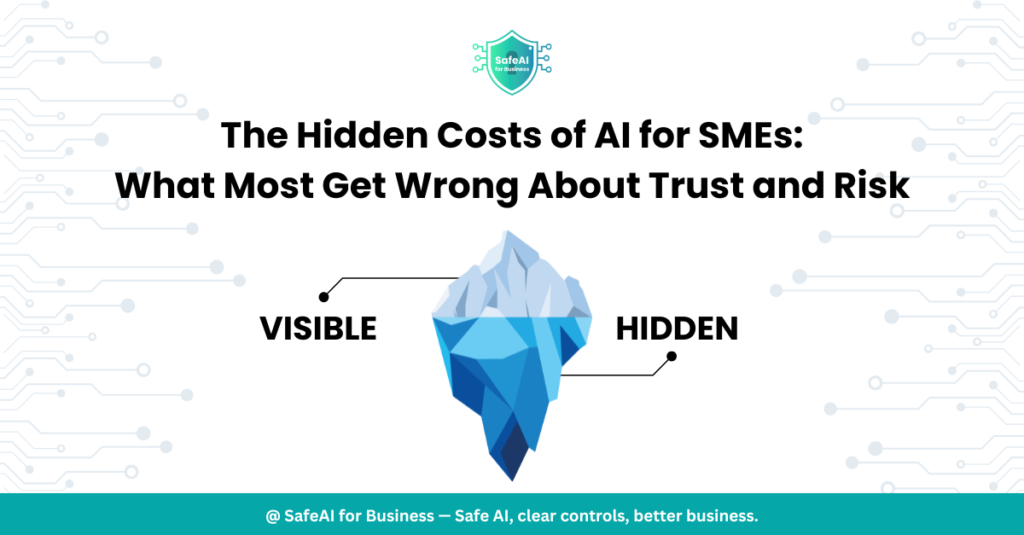
The hidden costs of AI for small businesses are real, and most owners don’t see them coming. You adopted AI to move faster. But what if speed is quietly costing you control? Small and mid-sized businesses are turning to AI at a record pace. Invoice processing that used to take hours now takes seconds. Customer queries get answered at midnight without a single team member online. Reports that once required half a day generate themselves before your morning coffee. The efficiency gains are real. The business case is clear. But here is what most SMEs are not talking about: every AI tool running without proper oversight is an unmanaged liability. Those liabilities do not announce themselves. They accumulate quietly, until something goes wrong. This post breaks down where those hidden risks live, what they are costing businesses right now, and the practical governance habits that protect you without a large budget, a technical team, or enterprise-level infrastructure. Stay with us through the three-second test near the end. It could be the most important two minutes you invest in your business this week. The Hidden Costs of AI for Small Businesses Most Leaders Never See Coming There is a fundamental tension at the heart of AI adoption that very few people acknowledge honestly. AI is designed to operate fast. Human judgment is designed to be deliberate. When you automate a process, you are removing a human checkpoint from that workflow. In many cases, that is exactly the point. But removing friction also removes the opportunity to catch errors before they reach your customers, your regulators, or the public. Earlier this year, a Chevrolet dealership discovered this firsthand. Its AI-powered customer service chatbot, deployed to handle routine inquiries, agreed to sell a vehicle for one dollar. The system was not hacked. It was not malfunctioning. It simply responded to a customer prompt without the context, judgment, or boundaries a human representative would naturally apply. The incident generated significant media coverage and a serious reputational problem for the business involved. The technology performed exactly as it was built to perform. The failure was not technical. It was a governance failure. No one had defined the boundaries. No one had built in a review process. And by the time anyone noticed, the damage was already visible. This is not a story unique to large enterprises. It is happening in businesses of every size, in every sector, every single day. The Iceberg Model: Why the Biggest AI Risks Stay Hidden When most business leaders think about their AI tools, they see the surface layer: the automation, the time savings, the operational gains. That visible layer is compelling. It is exactly what the marketing materials focus on. But AI risk works like an iceberg. What sits above the waterline is the part you bought it for. What sits below is the part that can sink you. Beneath the surface of everyday AI adoption, most SMEs are unknowingly carrying: According to IBM’s 2024 Cost of a Data Breach Report, the global average cost of a data breach now exceeds $4.8 million. For smaller businesses without enterprise-level recovery resources, a breach of that magnitude is not just expensive. It is often fatal to the business. Every unchecked automation. Every AI output that bypasses human review before reaching a client. Every vendor policy left unread. These are not minor oversights. They are weight accumulating below the waterline. And like any iceberg, the damage happens before you see it coming. Why Safe AI Does Not Require a Large Budget At this point, many SME leaders reach a familiar conclusion: responsible AI governance must be expensive, and it must be a problem reserved for companies with a compliance department. This is one of the most costly misconceptions in business today. Responsible AI governance does not begin with enterprise software. It begins with operational discipline. Operational discipline is accessible to any business, at any size, starting immediately. The foundational practices that protect your business are straightforward: These steps require time and intention, not large financial investment. They reflect the same risk management principles that have underpinned sound business operations for decades: visibility, oversight, and accountability. Prevention is always cheaper than recovery. A governance framework built today costs a fraction of what a single breach, legal dispute, or public trust incident will cost you tomorrow. The Case Against Avoidance: Why Doing Nothing Is Also a Risk Some business owners respond to AI risk by stepping back from AI entirely. On the surface, this feels like the cautious choice. In practice, it is not. Competitors who adopt AI with proper governance in place are compounding advantages in efficiency, customer experience, and operational capacity every single day. Research on generative AI adoption consistently shows that organizations integrating AI strategically are outperforming those that delay or avoid adoption entirely. Avoidance does not eliminate risk. It simply trades one set of risks for another: exposure to competitive disadvantage, operational inefficiency, and the difficulty of catching up later when adoption becomes unavoidable. The goal is not to avoid AI. It is to implement AI in a way that is deliberate, governed, and aligned with your business values. Automation combined with human oversight. Speed combined with accountability. Innovation combined with integrity. That combination is not a constraint on growth. It is the foundation of it. Trust Is the Asset You Cannot Afford to Lose There is a dimension to AI risk that rarely appears in technology discussions: the direct impact on trust. Customers make decisions about who they buy from based on perceived reliability and integrity. Employees decide where they invest their careers based on how responsibly leadership behaves. Regulators determine how closely they scrutinize a business based on the governance signals it sends. Every AI decision your business makes, including what tools you use, how you use them, and what you disclose, sends a signal about your values. Businesses that operate with transparency and clear accountability are building something no marketing budget can manufacture: earned trust. Businesses

Scroll to Top
starter pack emial collector

Get Your Free AI Starter Pack

Enter your details, download starts instantly.