Author name: SafeAI for Business

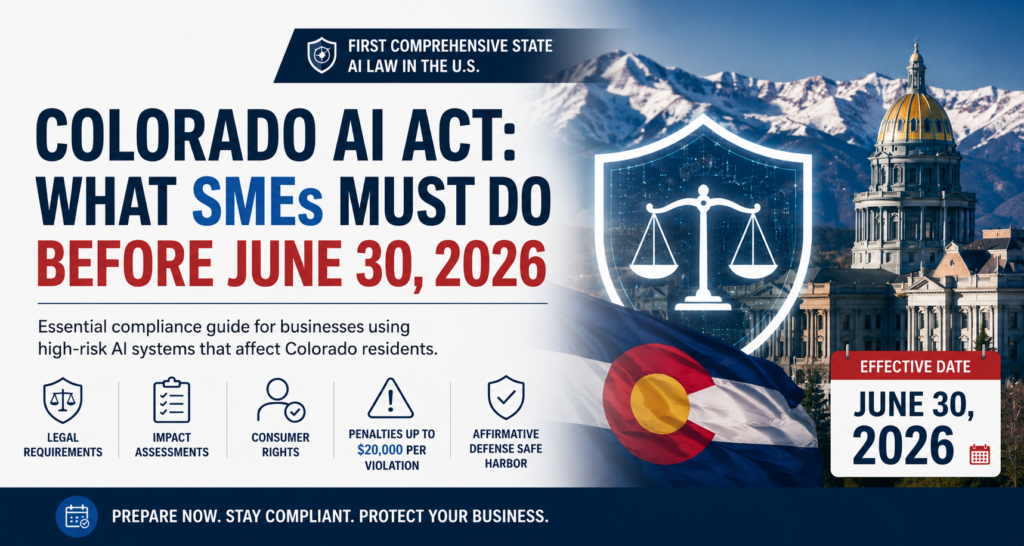
Colorado AI Act compliance guide for SMEs showing June 30 2026 deadline and high-risk AI consequential decision categories
AI for Business, AI Governance

Colorado AI Act: What SMEs Must Do Before June 30, 2026

About This Law Official Name: Colorado Artificial Intelligence Act (CAIA) – Colorado SB 24-205 Originally Signed: May 17, 2024 by Governor Jared Polis Effective Date: June 30, 2026 (delayed from February 1, 2026 following a special legislative session) Jurisdiction: State of Colorado, USA. Applies extraterritorially to any company making consequential decisions affecting Colorado residents, regardless of where the company is based. Type: First comprehensive state-level AI law in the United States Applies To: Developers and deployers of high-risk AI systems used for consequential decisions affecting Colorado residents Maximum Penalties: Up to USD 20,000 per violation per affected consumer. Violations constitute unfair trade practices under Colorado Consumer Protection Act. Enforcement: Colorado Attorney General (exclusive enforcement, no private right of action). 60-day cure period after notice. Safe Harbor: Documented alignment with NIST AI RMF or ISO/IEC 42001 and cure within 90 days of discovering violation. Introduction Your AI hiring tool just screened 500 applications. Your AI credit model just declined 200 loan requests. If any of those decisions affected Colorado residents, your company has new legal obligations starting June 30, 2026. Colorado SB 24-205 is the United States’ first comprehensive state AI law. Despite multiple attempts to scale it back, the core requirements remain unchanged. The Colorado Attorney General has exclusive enforcement authority, with penalties reaching USD 20,000 per violation per affected consumer. For an AI system touching hundreds of applicants, that exposure compounds fast. Read on for the complete breakdown of who this law covers, what it requires, and the practical compliance steps you need to take before June 30. What Is the Colorado AI Act Targeting? Algorithmic discrimination is the legal target. The CAIA defines it as unlawful differential treatment based on protected characteristics (race, age, sex, disability, religion, and others) caused by an AI system. The law exists because AI systems can produce discriminatory outcomes even when developers and deployers never intended discrimination. The CAIA places responsibility on both the companies that build AI systems (developers) and the companies that use them to make decisions (deployers). If you buy a third-party AI tool and use it to screen job candidates, you are a deployer under Colorado law. You cannot outsource your compliance obligation to your vendor. What Counts as High-Risk AI Under the CAIA? An AI system is high-risk if it makes or substantially influences a consequential decision. A consequential decision is one that has a significant effect on a consumer’s access to or the cost of education, employment, financial services, essential government services, healthcare, housing, or insurance. Examples include: resume screening and candidate ranking tools, credit scoring and loan decision systems, insurance underwriting and pricing algorithms, medical risk stratification tools, tenant screening software, and educational assessment systems. If your AI system plays a meaningful role in any of these decisions for Colorado residents, you are almost certainly in scope. Deployers with fewer than 50 employees are exempt from the annual impact assessment requirement, unless they use their own data to train or customize the high-risk AI system. That exemption disappears the moment you do custom training work. What the CAIA Requires of Developers and Deployers Developers must: use reasonable care to protect consumers from algorithmic discrimination, document known foreseeable risks and intended uses, provide deployers with a statement describing those risks, conduct regular impact assessments, and disclose discovered discrimination to the Colorado Attorney General within 90 days. Deployers must: implement a documented risk management policy and program, complete an annual impact assessment of each high-risk AI system, notify consumers before deploying a high-risk AI system to make a consequential decision about them, provide a plain-language explanation of how the system works, give consumers the right to appeal automated decisions and request human review, and report discovered discrimination to the Attorney General. The Affirmative Defense: How to Protect Your Business The CAIA provides a meaningful safe harbor. A developer or deployer is not liable for a violation if they have complied with a nationally or internationally recognised AI risk management framework (such as the NIST AI RMF or ISO/IEC 42001) and they discover and cure the violation within 90 days of discovery. Aligning with the NIST AI RMF is not just good governance practice. It is a legal shield under Colorado law. Document your alignment, maintain records of your risk assessments, and implement the cure procedures before June 30. Your 5-Step CAIA Compliance Plan Frequently Asked Questions Does the Colorado AI Act apply to companies based outside Colorado? Yes. The CAIA applies to any company that deploys a high-risk AI system to make consequential decisions affecting Colorado residents. A New York company using AI to screen applicants from Denver must comply, as must a San Francisco fintech approving loans for Colorado borrowers. What are the penalties for violating the Colorado AI Act? Violations constitute unfair trade practices under the Colorado Consumer Protection Act. The maximum penalty is USD 20,000 per violation, counted separately for each affected consumer or transaction. An AI system that discriminates against 100 consumers could generate up to USD 2 million in penalties. Is the Colorado AI Act still subject to change? Colorado lawmakers can make amendments during the 2026 legislative session before the June 30 effective date. However, the core framework including developer and deployer obligations and the consequential decision trigger has remained stable. Build compliance around the current text. How does the Colorado AI Act interact with the EU AI Act? The laws share a risk-based philosophy and overlapping concepts, but Colorado focuses specifically on algorithmic discrimination protection for Colorado residents while the EU AI Act covers a broader range of AI risks. Build a unified compliance programme that addresses the specific requirements of each. Conclusion The Colorado AI Act is the United States’ most demanding state-level AI law, and it takes effect on June 30, 2026. The operational requirements, including annual impact assessments, consumer notifications, appeal workflows, and 90-day disclosure obligations, all take time to implement properly. Businesses that align with a recognised AI risk management framework now build both legal protection
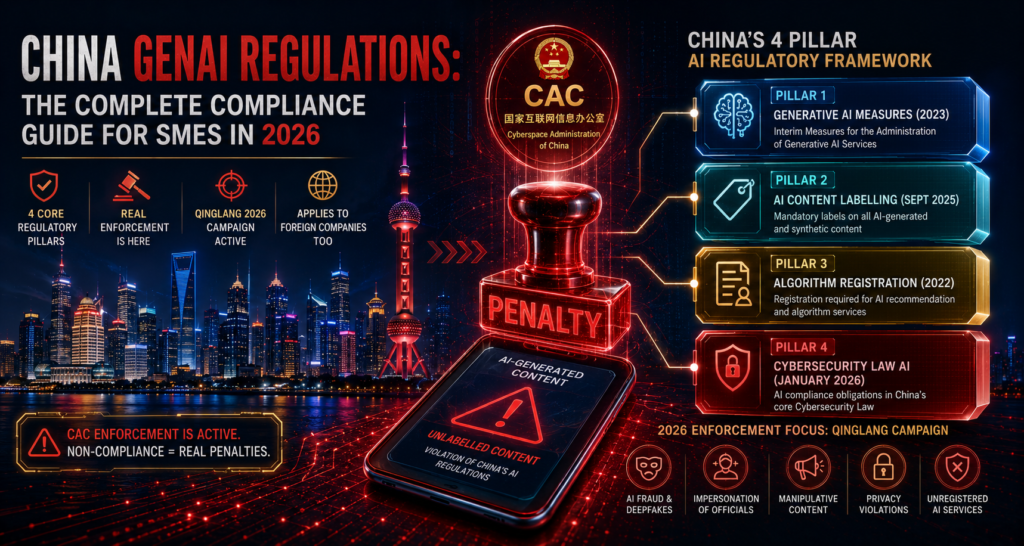

China GenAI regulations compliance
Uncategorized

China GenAI Regulations: The Complete Compliance Guide for SMEs in 2026

About This Framework Framework Type: Multi-layered regulatory regime. Four core pillars. No single AI Act. Pillar 1: Generative AI Measures: Interim Measures for the Administration of Generative AI Services. Effective August 15, 2023. World’s first binding generative AI regulation. Issued by CAC jointly with six ministries. Pillar 2: AI Content Labelling: Administrative Measures for the Labelling of AI-Generated and Synthetic Content. Issued March 14, 2025. Effective September 1, 2025. Mandatory explicit and implicit labels on all public AI-generated content. Pillar 3: Algorithm Registration: Administrative Provisions on Algorithm Recommendation. Effective March 1, 2022. Registration with CAC required for AI recommendation services. Pillar 4: Cybersecurity Law AI Amendments: Effective January 1, 2026. First inclusion of AI compliance obligations in China’s core national Cybersecurity Law. Latest Enforcement (April 2026): CAC penalised CapCut, Maoxiang, and Dreamina AI for AI content labelling violations. First high-profile penalties under September 2025 labelling rules. 2026 Enforcement Campaign: Qinglang 2026 campaign: CAC and Ministry of Public Security targeting AI fraud, deepfakes, celebrity impersonation, and privacy violations. Draft Rules (April 2026): CAC published draft rules for digital virtual human services (April 3, 2026). Consent for likeness use, AI companion safety, and platform liability provisions. Primary Regulator: Cyberspace Administration of China (CAC). MIIT, Ministry of Public Security, and NRTA have overlapping jurisdiction. Introduction In April 2026, the Cyberspace Administration of China (CAC) penalised CapCut, Maoxiang (Cat Box), and Dreamina AI for failing to properly label AI-generated content. All three apps violated China’s Cybersecurity Law, the Interim Measures for Generative AI Services, and the AI labelling provisions that took effect September 1, 2025. The CAC did not issue warnings. It imposed penalties directly. Enforcement is real, it is active, and it extends to international platforms operating in China. China’s annual Qinglang (Clear and Bright) AI enforcement campaign is underway for 2026, targeting AI-enabled fraud, deepfakes, impersonation of celebrities and officials, and illegal AI applications violating privacy and intellectual property. CAC has also published draft rules for digital virtual human services (April 3, 2026). China’s AI regulatory framework is expanding in real time. This guide covers China’s four core AI regulatory pillars, the latest enforcement actions, and the practical compliance steps every SME must take to protect its position in the Chinese market. Why China’s AI Framework Demands Immediate Attention in 2026 The April 2026 enforcement actions against CapCut, Maoxiang, and Dreamina AI are the most significant signal yet that China’s AI labelling rules are fully operational. CapCut, owned by ByteDance, is one of the most widely used video editing platforms in the world. If the CAC is willing to penalise ByteDance’s own applications, the enforcement posture for all operators, including foreign brands, is unambiguous. The Qinglang 2026 campaign adds a second dimension, running across multiple phases through mid-2026, targeting AI-enabled fraud using voice-cloning and face-swapping deepfakes, non-consensual AI resurrection of deceased individuals, unregistered AI products, and AI content manipulating public opinion. Pillar 1: The 2023 Generative AI Measures The Interim Measures for the Administration of Generative AI Services, effective August 15, 2023, remain the foundation of China’s AI regulatory framework. Pillar 2: AI Content Labelling (Now Being Actively Enforced) China’s Administrative Measures for the Labelling of AI-Generated and Synthetic Content took effect September 1, 2025. The April 2026 enforcement actions against CapCut and Dreamina AI confirm these rules are being actively enforced. The labelling requirement operates on two levels. Explicit labels are visible to users and must appear on all AI-generated text, images, audio, video, and virtual scenes. Implicit labels are technical metadata identifiers embedded by AI systems or platforms. Both types are required. Visible labels alone do not satisfy the rules. All major Chinese platforms (WeChat, Douyin, Weibo, Xiaohongshu, Bilibili, Tmall, JD.com) are covered. Any AI-assisted marketing campaign distributed on these platforms by any brand, including foreign brands, must carry both types of labels. Running AI-generated campaigns on Chinese platforms? The CAC is actively penalising unlabelled AI content in 2026. Book a free China AI compliance review and make sure your labelling, filing status, and data governance are in order before your next campaign. Pillar 3: Algorithm Registration China’s Algorithm Recommendation Provisions (effective March 2022) require any provider of algorithm-based recommendation services to register with the CAC. This applies to AI systems personalising content, product listings, search results, or user experiences for Chinese users. For foreign e-commerce brands with Chinese stores on Tmall or JD.com using personalised AI recommendations, algorithm registration is a legal requirement. Regional CAC offices are actively penalising unregistered AI applications. Use your Chinese platform partner or local legal representative to complete this filing. Pillar 4: The Amended Cybersecurity Law and Draft Virtual Human Rules China’s amended Cybersecurity Law (effective January 1, 2026) brings AI into China’s core national law for the first time, creating explicit AI ethics review obligations and AI security governance requirements for network operators. New CAC draft rules for digital virtual human services (published April 3, 2026) cover consent requirements for AI-generated likenesses of real individuals, safety requirements for AI companion services, and platform liability. Final rules are expected in 2026 or early 2027. Businesses deploying AI-generated presenters, avatars, or companion characters in China-facing products should track these rules. Practical Compliance Checklist for Foreign SMEs Frequently Asked Questions Did the CAC really penalise major platforms for AI labelling violations? Yes. In April 2026, the CAC issued formal penalties against CapCut (owned by ByteDance), Maoxiang (Cat Box), and Dreamina AI for violating the AI-generated content labelling requirements. This confirms the CAC is willing to penalise even major domestic platforms. What is the Qinglang enforcement campaign? Qinglang (Clear and Bright) is an annual CAC-coordinated enforcement campaign. The 2026 edition targets AI-enabled fraud, deepfakes used for impersonation, non-consensual AI resurrection of deceased individuals, AI manipulation of public opinion, and unregistered AI services. It runs across multiple phases through mid-2026. Do China’s AI regulations apply to foreign companies based outside China? Yes. The Generative AI Measures and AI labelling rules apply based on where users are located, not where the company is incorporated. The April 2026 penalty

South Korea AI Basic Act compliance
AI for Business, AI Governance

South Korea AI Basic Act: What Foreign Companies Must Know in 2026

About This Law Official Name: Act on the Development of Artificial Intelligence and the Establishment of a Foundation for Trust (AI Basic Act / AI Framework Act), Act No. 20676 Passed by National Assembly: December 26, 2024 Promulgated: January 21, 2025 Enforcement Decree Effective: January 22, 2026 (Presidential Decree No. 36053) Jurisdiction: Republic of Korea. Extraterritorial: applies to any foreign business whose AI activities affect Korean market users. Grace Period: At least one year from January 22, 2026. Fines deferred except for exceptional cases involving serious social harm (loss of life or human rights violations). High-Performance AI Threshold: AI systems trained with cumulative compute of at least 10^26 FLOPs. Roughly 10 times EU AI Act GPAI threshold. Primarily targets global big-tech GPAI operators. High-Impact AI Categories: Employment, healthcare, financial services, public safety, education. Mandatory lifecycle risk management, impact assessments, and compliance reporting. Generative AI Obligation: Any business producing AI-generated content visible to Korean users must notify users in advance and label outputs that may be difficult to distinguish from non-AI content. Governing Ministry: Ministry of Science and ICT (MSIT). National AI Committee (under President). AI Safety Research Institute. Implementation Task Force: AI Basic Act Institutional Improvement Task Force launched March 2026. 40+ experts across industry, academia, civil society. Refining implementation during grace period. Introduction On January 21, 2025, South Korea became the second jurisdiction in the world, after the European Union, to enact comprehensive AI legislation. The Act on the Development of Artificial Intelligence and the Establishment of a Foundation for Trust (Act No. 20676), known as the AI Basic Act or AI Framework Act, was passed by the National Assembly on December 26, 2024, promulgated on January 21, 2025, and took full legal effect on January 22, 2026. Since the Act took effect, MSIT has clarified several key compliance details. The high-performance AI threshold has been confirmed at systems trained with a cumulative compute of at least 10 to the power of 26 floating-point operations (FLOPs), roughly ten times the EU AI Act’s general-purpose AI model threshold. A multi-stakeholder AI Basic Act Institutional Improvement Task Force of more than 40 experts launched in March 2026 to refine implementation during the one-year grace period. This guide breaks down who the Act applies to, the clarified compliance details, and the practical steps foreign SMEs must take before the grace period ends and enforcement fines begin. Why South Korea’s AI Law Is a Landmark Moment for Asia-Pacific Before the AI Basic Act, South Korea had more than 20 separate AI governance bills circulating through the National Assembly. The Act consolidated them into a single unified framework, balancing industrial promotion with safety, transparency, and human rights protection. It is the world’s first comprehensive AI law in the Asia-Pacific region and only the second globally after the EU AI Act. New President Lee Jae-myung has publicly defined AI as a game-changer that will shift the global economic paradigm, presenting it as a core engine for South Korea’s technology-led growth. The government is pairing regulation with significant AI investment: startup support programmes, government-funded training data access, and AI Growth Zones with reduced regulatory requirements. Does the South Korea AI Basic Act Apply to Your Company? The Act applies to both domestic and foreign AI business operators. The foreign company domestic representative requirement is triggered when a company meets any one of three thresholds. For most SMEs, these thresholds mean the domestic representative requirement does not immediately apply. However, High-Impact AI requirements and the generative AI user notification obligation apply to any business operating in Korea regardless of size. High-Impact AI: The Core Compliance Category High-Impact AI is the Act’s central compliance concept: AI systems that may significantly affect human life, safety, or fundamental rights. For High-Impact AI, operators must implement lifecycle risk identification and mitigation, maintain incident monitoring systems, conduct fundamental rights impact assessments before deployment, and report compliance information to MSIT. Operating an AI system in South Korea that may qualify as High-Impact AI, or using generative AI that produces content for Korean users? Book a free compliance assessment. Our team reviews your AI use cases against the Act’s definitions and tells you exactly what obligations apply. The High-Performance AI Threshold: 10 to the Power of 26 FLOPs MSIT confirmed in the Enforcement Decree that AI systems trained with a cumulative compute of at least 10 to the power of 26 floating-point operations (FLOPs) are designated as high-performance AI and subject to additional safety obligations. This threshold is roughly ten times higher than the EU AI Act’s GPAI model computation threshold. This was a deliberate policy choice targeting only the most powerful global AI systems, primarily from US and Chinese big tech companies, while exempting the vast majority of commercially deployed AI. Most SMEs are well below this threshold. The Domestic Representative Requirement Explained Foreign AI business operators that meet the revenue or user thresholds must designate a domestic representative in South Korea and report that designation to MSIT. The representative bears legal accountability for the company’s compliance and must have a domestic Korean address or place of business. The April 2025 amendment to Korea’s PIPA tightened these rules, requiring companies with established Korean business units to designate those units rather than unrelated third-party nominees. Frequently Asked Questions When did the South Korea AI Basic Act take effect? The Act and its Enforcement Decree both took effect on January 22, 2026. A one-year grace period applies to administrative fines, with exceptions for exceptional cases involving serious social harm. Substantive compliance obligations apply from January 22, 2026. What is the high-performance AI FLOPs threshold and does it affect my business? MSIT confirmed the threshold at 10^26 FLOPs of cumulative compute. This primarily affects global frontier AI model developers such as OpenAI, Google, and Anthropic. Most SMEs and mid-size AI companies are well below this threshold. Does the AI Basic Act apply to internal AI tools used by a Korean subsidiary? Yes, if those tools make decisions affecting Korean employees. HR AI systems, performance evaluation

UK AI regulation
AI for Business, AI Governance

UK AI Regulation: A Complete Guide for Small Businesses in 2026

About This Framework Primary Framework: UK AI White Paper: A Pro-Innovation Approach to AI Regulation (DSIT, March 2023). Five cross-sector principles: Safety/security/robustness, Transparency/explainability, Fairness, Accountability/governance, Contestability/redress. DSIT Blueprint (October 2025): Replaces AI Bill as immediate legislative vehicle. Introduces AI Growth Lab: sectoral sandboxes where regulations can be relaxed under licence for approved AI innovators. Data Use and Access Act 2025: Royal Assent June 19, 2025. Bulk of provisions commenced February 5, 2026. New recognised legitimate interests basis for automated decision-making now in force. Section 103 complaints procedure commences June 19, 2026. Deepfake Criminal Law: Crime and Policing Act amendment in force from February 6, 2026. Criminalises creation of sexually explicit deepfake images of adults without consent. Copyright and AI Report: Published March 18, 2026 (required by DUAA 2025). Government maintains status quo on AI/copyright for now. AI Bill Status: As of June 2026, still expected but not introduced. Government deliberately delayed to resolve AI/copyright interaction. Penalties Under Existing Law: UK GDPR: GBP 17.5M or 4% global turnover. FCA, Ofcom, CMA retain separate enforcement powers. Deepfake criminal law: criminal prosecution. Key Regulators: ICO, FCA, Ofcom, CMA, MHRA, AI Security Institute/DSIT. Introduction No single AI law. No risk tiers. No mandatory impact assessments. The UK has deliberately chosen a principles-based, sector-led model rather than following the EU’s comprehensive AI Act approach. As of June 2026, there is still no UK AI Act. But that absolutely does not mean no rules apply to your AI systems. In 2026, UK AI regulation is moving on multiple tracks simultaneously. The Data (Use and Access) Act 2025 commenced in February 2026. A deepfake criminal law took effect on February 6, 2026. The government published the Copyright and AI Report on March 18, 2026. The DSIT Blueprint for AI Regulation, published in October 2025, introduces the AI Growth Lab concept. And a government-backed AI Bill remains expected but has not yet been introduced. This guide explains every active UK AI rule as of June 2026, which sector regulators apply them, and the practical compliance steps your business must take right now. The Current UK AI Framework: What Is Actually In Force The UK’s AI governance landscape as of June 2026 is built on layers rather than a single law. The foundational layer is the five White Paper principles from March 2023: safety/security/robustness, transparency/explainability, fairness, accountability/governance, and contestability/redress. These are not statutory. They are guidance that each sector regulator applies within its own binding framework. The second layer is the Data (Use and Access) Act 2025, in force from February 5, 2026. The most important change for AI businesses: the new recognised legitimate interests lawful basis for automated decision-making means UK GDPR’s ADM rules are now more accessible. The near-blanket prohibition that previously made solely automated decisions difficult to lawfully deploy has been replaced by a legitimate interests framework with genuine human oversight and transparency safeguards. New Laws Already In Force: What Changed in 2026 Three significant developments have changed the UK AI compliance landscape since January 2026. The deepfake criminal law is the most immediate. From February 6, 2026, the Crime and Policing Act amendment makes it a criminal offence to create sexually explicit deepfake images of adults without their consent. Businesses deploying any AI capable of generating such content face direct criminal liability without adequate consent and safety controls. The DUAA automated decision-making framework creates new operational requirements. The new recognised legitimate interests basis for ADM removes the previous consent barrier, but requires genuine human oversight, transparent contestation mechanisms, and a documented balancing test. The Copyright and AI Report (March 18, 2026) confirmed the government’s status quo on AI training data: no text-and-data mining exception was introduced. AI systems trained on copyrighted UK content without licences remain legally exposed. Which Regulator Oversees Your AI? The Sector Guide Unsure which UK regulators apply to your specific AI systems, or whether the new DUAA ADM framework changes your current legal basis for automated decisions? Download our free UK AI compliance readiness guide, updated for June 2026. The DSIT Blueprint and the AI Growth Lab Published October 21, 2025, the DSIT Blueprint for AI Regulation replaced the long-awaited AI Bill as the government’s immediate legislative vehicle. The centrepiece is the AI Growth Lab: a set of sectoral sandboxes where specific regulations can be relaxed under licence for approved AI innovators. For SMEs, the AI Growth Lab represents a genuine opportunity. Approved participants can test AI systems in regulated environments (healthcare, financial services, energy) with temporary relief from specific sector regulations. The DSIT One Year On progress report (January 29, 2026) confirmed 38 of the 50 AI Opportunities Action Plan commitments are met. Your UK AI Compliance Action Plan for 2026 Frequently Asked Questions Does the UK have an AI Act? No. As of June 2026, no comprehensive UK AI Act has been passed. The government’s approach is the DSIT Blueprint and sector-led enforcement of existing law. A government-backed AI Bill is expected to be introduced in 2026, but no timeline has been confirmed. What does the DUAA 2025 change for businesses using automated decision-making? The Data (Use and Access) Act 2025, in force from February 2026, replaced the near-blanket prohibition on solely automated decisions with a recognised legitimate interests framework. Businesses can now more readily use automated decision-making under UK GDPR, but must implement genuine human oversight and transparent contestation mechanisms. Is creating deepfake images now a criminal offence in the UK? Yes, for sexually explicit images of adults. From February 6, 2026, the Crime and Policing Act amendment makes it a criminal offence to create sexually explicit deepfake images without the subject’s consent. Businesses deploying AI image or video generation tools face criminal liability without adequate safeguards. How does UK AI regulation compare to the EU AI Act? The EU AI Act is binding law with fines of up to 7% of global turnover (with high-risk deadlines extended to December 2027 via the Omnibus). UK regulation is principles-based and sector-led with no mandatory AI-specific impact assessment requirement.

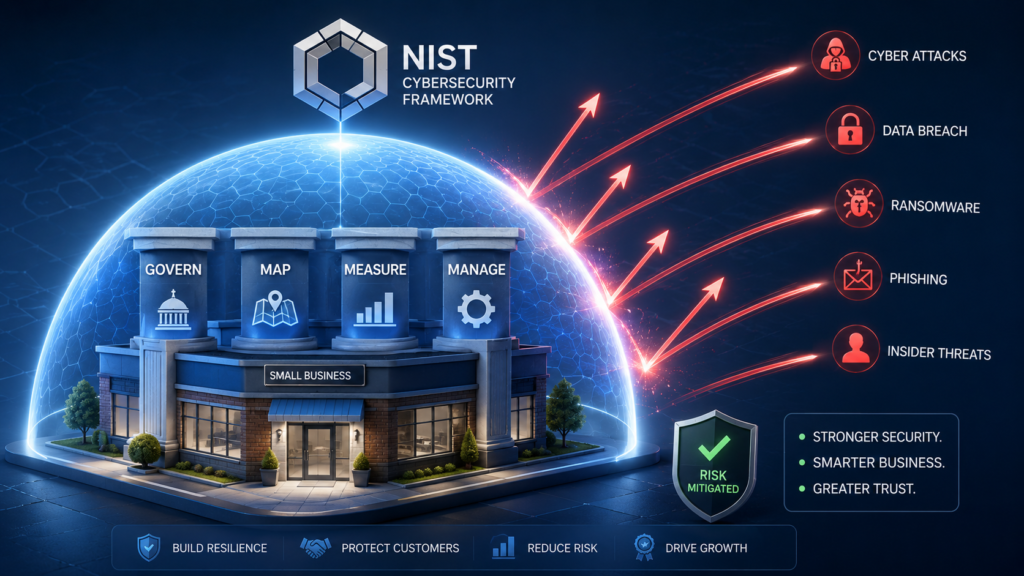
NIST AI Risk Management Framework
AI for Business, AI Governance

NIST AI Risk Management Framework: A Practical Guide for SMEs

About This Framework Official Name: NIST AI Risk Management Framework (AI RMF 1.0), NIST AI 100-1 Published By: National Institute of Standards and Technology (NIST), US Department of Commerce Published: January 26, 2023 Authorising Law: National Artificial Intelligence Initiative Act of 2020 (P.L. 116-283) Binding?: Voluntary. Not law. However, provides affirmative legal defense in Colorado AI Act (June 30, 2026) and Texas TRAIGA (January 1, 2026). Required in US federal government AI procurement. Global Adoption: Referenced in EU AI Act compliance, ISO/IEC 42001, Singapore AI Verify, Australia AI6 framework, UK DSIT guidance, and enterprise vendor questionnaires worldwide. Core Structure: Four functions: GOVERN, MAP, MEASURE, MANAGE. Nine trustworthy AI characteristics. Cost: Free. Full framework, Playbook, and Generative AI Profile available at airc.nist.gov. Latest Version: AI RMF 1.0 (Jan 2023). Generative AI Profile (NIST AI 600-1) published July 2024. Introduction The NIST AI Risk Management Framework (AI RMF 1.0) is a voluntary AI governance framework published by the US National Institute of Standards and Technology on January 26, 2023. It was built under the National Artificial Intelligence Initiative Act of 2020, developed over 18 months through a consensus process involving more than 240 organisations from industry, academia, civil society, and government. It is free, flexible, and designed for organisations of any size and sector. In 2026, the NIST AI RMF is referenced as an affirmative legal defence in Colorado’s AI Act and Texas TRAIGA, incorporated into ISO/IEC 42001, and used as the evaluation framework in Singapore’s AI Verify toolkit. Enterprise procurement teams across financial services, healthcare, and government are adding NIST AI RMF alignment to vendor questionnaires. Most SMEs adopt AI tools faster than they build governance around them. If something goes wrong and you cannot show a documented, defensible process for identifying, measuring, and managing AI risk, you are exposed both legally and commercially. The NIST AI RMF fixes that gap with minimal overhead. This guide walks you through the four core functions in plain language, with practical steps you can implement this week, no dedicated compliance team required. Why SMEs Cannot Afford to Ignore AI Governance in 2026 AI systems fail in ways that traditional software does not. A biased training dataset can produce discriminatory hiring outcomes at scale. A hallucinating AI assistant can give customers inaccurate information that creates legal liability. A poorly monitored model can drift over time, quietly degrading decisions in ways no human reviewer notices. For SMEs, the consequences of these failures are disproportionately severe. A single AI-related discrimination claim, a regulatory investigation, or a high-profile customer harm can consume operational resources that a large enterprise would absorb as a rounding error. Critically, 2026 is the year US state AI laws start imposing real compliance burdens. Colorado’s AI Act (effective June 30, 2026) and Texas TRAIGA (effective January 1, 2026) both reference NIST AI RMF alignment as an affirmative defence or safe harbor. Implementing the framework is now both good governance and a legal shield. The 4 Core Functions: Govern, Map, Measure, Manage The NIST AI RMF organises AI risk management into four interconnected functions that work across the AI lifecycle. GOVERN applies continuously across all stages. MAP, MEASURE, and MANAGE apply sequentially as each AI system moves through its lifecycle. The Generative AI Profile (NIST AI 600-1, July 2024) extends the framework to LLMs and foundation model deployments. Trustworthy AI: The 9 Characteristics the Framework Targets The NIST AI RMF defines trustworthy AI through nine characteristics. These are measurable properties, not aspirational values. For an SME starting from scratch, focus first on Valid and Reliable and Accountable and Transparent. These form the foundation for everything else and are the characteristics regulators, clients, and courts are most likely to ask about first. Want a free assessment of where your AI systems stand against the NIST AI RMF criteria, and whether your documentation would satisfy Colorado’s AI Act or Texas TRAIGA affirmative defence requirements? Book a 30-minute consultation and we will walk you through the gaps. Implementing the NIST AI RMF Without a Dedicated Team Why the AI RMF Is Now a Commercial Requirement Colorado’s AI Act (effective June 30, 2026) provides an affirmative defence to organisations complying with a nationally or internationally recognised AI risk management framework. The NIST AI RMF is the primary framework cited. Texas TRAIGA similarly recognises substantial compliance with the NIST AI RMF as a liability shield. ISO/IEC 42001, the international AI management system standard that is rapidly becoming the ISO 9001 of AI, builds on NIST AI RMF principles. Companies that implement the AI RMF now are typically ISO 42001 certification-ready with minimal incremental work. Frequently Asked Questions Is the NIST AI RMF mandatory in the United States? No. The NIST AI RMF is voluntary. However, it is referenced as an affirmative defence in Colorado’s AI Act and Texas TRAIGA, required in US federal government AI procurement, and increasingly demanded by enterprise clients as a condition of vendor approval. How does the Generative AI Profile (NIST AI 600-1) differ from the AI RMF 1.0? The AI RMF 1.0 is the foundational framework for all AI systems. NIST AI 600-1, published July 2024, extends the framework specifically to generative AI and large language models, addressing hallucination, data provenance, and intellectual property risks. How long does it take an SME to implement the NIST AI RMF? A basic implementation covering all four core functions can be completed in 4 to 8 weeks for a small organisation with a handful of AI systems. Ongoing maintenance requires roughly 2 to 4 hours per month. Where can I download the NIST AI RMF? The full AI RMF 1.0, the Playbook, NIST AI 600-1, and all supporting resources are available free at airc.nist.gov. Conclusion The NIST AI Risk Management Framework is the most practical AI governance tool available to SMEs today. In 2026, it is also a legal shield under US state AI laws and a commercial requirement for enterprise vendor relationships. The combination of free availability, legal benefit, and commercial necessity makes implementation an easy

GDPR AI compliance
AI Governance, Business Guides

GDPR and AI: What Every Business Must Know Before a Fine Arrives

About This Law Official Name: Regulation (EU) 2016/679, General Data Protection Regulation (GDPR) Adopted: April 27, 2016 Entered into Force: May 25, 2018 (all 27 EU member states simultaneously) UK Equivalent: UK GDPR retained under Data Protection Act 2018. Near-identical obligations, enforced by ICO. UK fines: GBP 17.5M or 4% global turnover. Jurisdiction: All 27 EU member states directly. Extraterritorial: applies globally to any organisation processing personal data of individuals located in the EU. Cumulative Fines (June 2026): EUR 7.1 billion across 2,800+ documented decisions. Q1 2026: EUR 68.18M in 3 months. France now second-largest enforcer after Ireland. Key AI-Specific Rule: Article 22: Right not to be subject to solely automated decisions with legal or similarly significant effects. DPIAs mandatory for high-risk AI processing. EDPB 2026 AI Ruling: AI models trained on personal data cannot in all cases be considered anonymous. The burden of proof is on the controller to demonstrate anonymisation. Maximum Penalties: EUR 20M or 4% global annual turnover (serious violations); EUR 10M or 2% (technical violations). Whichever is higher. Enforcement Body: 27 national DPAs. EDPB coordinates cross-border enforcement. Introduction GDPR cumulative fines crossed EUR 7.1 billion in early 2026, with more than 60% of that total imposed since January 2023 alone. The first quarter of 2026 alone produced EUR 68.18 million in fines, a pace of roughly EUR 757,600 per day. France’s CNIL imposed a EUR 42 million combined fine on Free Mobile and Free SAS in January 2026 for a data breach affecting 24 million subscriber records. The regulatory machine is not slowing down. It is accelerating. The GDPR was not written with AI in mind, but it governs every AI system that processes personal data of EU residents. Your AI hiring tool, your AI credit scorer, your AI customer service bot: every single one is subject to GDPR with fines reaching EUR 20 million or 4% of global turnover. And in a landmark statement, the European Data Protection Board (EDPB) has ruled that AI models trained on personal data cannot, in all cases, be considered anonymous. That single line resets the compliance burden for every organisation whose AI has ever touched EU personal data. Keep reading to learn the six GDPR obligations every AI deployer must meet, and the steps to address the EDPB anonymisation ruling before it becomes the basis of an enforcement action against your business. What Is GDPR and Why Does It Cover AI? GDPR is a directly applicable EU regulation that became enforceable on May 25, 2018, replacing the 1995 Data Protection Directive. Its jurisdiction is anchored to where the data subject is located, not where the company is based: if your AI processes personal data of a person located in the EU, GDPR applies to you regardless of where your company is headquartered. The GDPR creates a compliance thread through the entire AI lifecycle. Training data, validation data, model weights derived from personal data, and inference-time decisions about identifiable individuals are all in scope. The EDPB has made this explicit: if personal data contributed to training an AI model, that model is subject to GDPR obligations, even when you believe the personal data has been removed from the final model. France’s CNIL, Germany’s BfDI, and Ireland’s DPC are the most active AI enforcement authorities in 2026. CNIL became the second-largest enforcer globally in 2025, behind only Ireland’s DPC. The EDPB Anonymisation Ruling: A Game-Changer for AI Training The most significant GDPR development of 2026 for AI businesses is the EDPB’s ruling on AI model anonymisation. The EDPB has stated that AI models trained on personal data cannot, in all cases, be considered anonymous. Many organisations trained AI models on personal data, removed the raw data from production systems, and treated the trained model as outside GDPR scope. The EDPB’s position challenges this. The model itself, through inference attacks or memorisation, may retain information that allows re-identification. The burden is now on the data controller to demonstrate that anonymisation is effective. The practical implication: if you cannot demonstrate with confidence that your AI model does not retain personally identifiable information, GDPR applies to the model itself, not just the training data. Build anonymisation assessments into your DPIA process and document them before deployment. Article 22: The Rule That Changes Everything About Automated Decisions Article 22 of GDPR gives individuals the right not to be subject to decisions based solely on automated processing that produce legal or similarly significant effects. Three key obligations follow from Article 22. First, if you make a solely automated decision with significant effects on an individual, you must have a valid legal basis: explicit consent, contractual necessity, or specific legal authorisation. Second, individuals must be able to request human review. Third, individuals must be able to contest the decision. Courts and regulators have confirmed that credit scoring, insurance pricing, employment screening, and loan decisions all trigger Article 22. A Berlin bank was fined EUR 300,000 in 2023 for rejecting a credit card application via an automated process without providing an explanation. The individual could not challenge or understand the decision: a textbook Article 22 violation that can happen to businesses of any size. Data Protection Impact Assessments for AI: When They Are Mandatory A DPIA is mandatory when your AI system poses a high risk to individuals’s rights and freedoms. Several categories of AI processing trigger this automatically. Under the EDPB’s anonymisation ruling, add a new category: any AI system trained on personal data where you cannot affirmatively demonstrate that the model retains no re-identifiable information. Concerned your AI systems may already have GDPR exposure, including under the EDPB anonymisation ruling? Book a free GDPR AI compliance audit. Our specialists review your AI stack and identify gaps before they become enforcement actions. The 6 GDPR Obligations Every AI Deployer Must Meet GDPR and the EU AI Act: Double Compliance in 2026 For businesses subject to both GDPR and the EU AI Act, the two frameworks overlap significantly. Note that the EU AI Act Omnibus (May 7,

EU AI Act compliance SMEs
Uncategorized

EU AI Act Compliance for SMEs: The Complete 2026 Guide

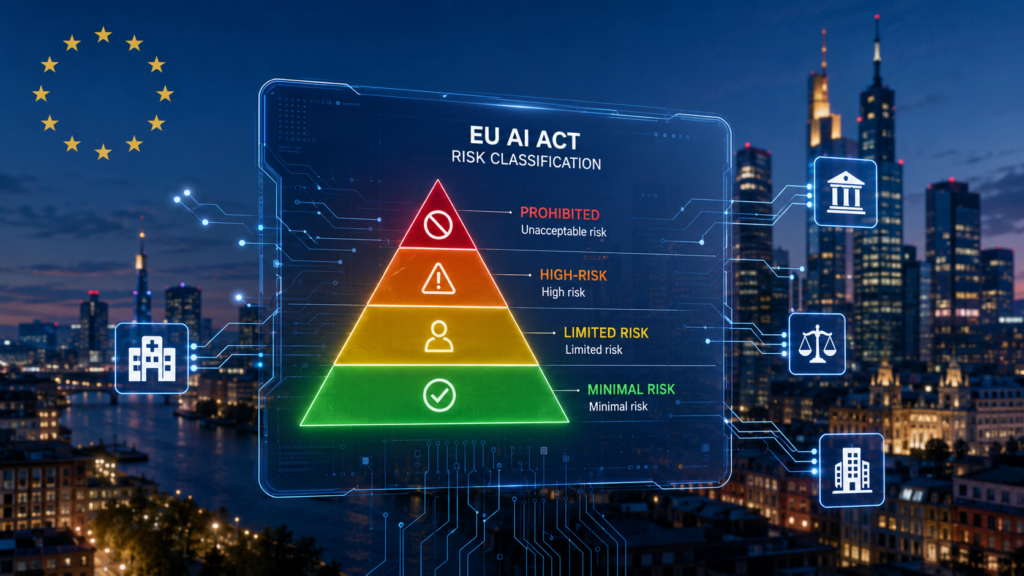
About This Law Official Name: Regulation (EU) 2024/1689, EU AI Act, amended by Digital Omnibus on AI (political agreement May 7, 2026; formal adoption expected July 2026) Entered into Force: August 1, 2024. Omnibus amendments expected in Official Journal before August 2, 2026. Jurisdiction: All 27 EU member states directly. Extraterritorial: any organisation worldwide placing AI on EU market or whose AI outputs are used within the EU. Prohibited AI (Active Now): In force since February 2, 2025. Social scoring, subliminal manipulation, real-time biometric surveillance (narrow exceptions), exploitation of vulnerabilities. NEW: AI-generated non-consensual intimate imagery (nudifiers) and CSAM added by Omnibus. GPAI Model Obligations: In force since August 2, 2025. General-purpose AI model providers must maintain technical documentation, comply with copyright law, publish summaries of training data. Article 50 Transparency (Active August 2, 2026): Chatbot disclosure, emotion recognition labelling, deepfake marking. UNCHANGED by Omnibus. Watermarking (Article 50(2)): NEW deadline December 2, 2026. High-Risk AI Annex III Standalone (Updated): Employment, credit, education, biometrics, law enforcement, critical infrastructure: NEW deadline December 2, 2027 (was August 2, 2026). Grandfathering: systems placed on market before this date not subject to HRAIS requirements unless substantially modified. High-Risk AI Annex I Products (Updated): Medical devices, machinery, toys, vehicles: NEW deadline August 2, 2028 (was August 2, 2027). Maximum Penalties: EUR 35M or 7% global turnover (prohibited practices); EUR 15M or 3% (high-risk non-compliance); EUR 7.5M or 1.5% (transparency/watermarking). Lower caps for SMEs. SME Extensions: Omnibus extends SME compliance simplifications to Small Mid-Cap companies (SMCs) with up to 750 employees and EUR 150M annual revenue. Introduction Everything you read about August 2, 2026 being the EU AI Act deadline for high-risk AI just became outdated. On May 7, 2026, the European Parliament and the Council reached a political agreement on the Digital Omnibus on AI, the most significant amendment to the EU AI Act since it entered force. The headline change: the compliance deadline for most high-risk AI systems has been extended from August 2, 2026 to December 2, 2027. For standalone Annex III systems, that is 16 additional months. For high-risk AI embedded in regulated products, the new deadline is August 2, 2028. The Omnibus was prompted by a stark reality: technical standards and guidance documents that businesses need to implement high-risk AI requirements are not ready. Implementation was visibly off track. The co-legislators extended the deadline rather than rush compliance against standards that do not yet exist. Formal adoption is expected by July 2026, before the original August deadline. Here is what this means for your SME: the extra time is a gift, not a licence to pause. Article 50 transparency obligations (chatbot disclosure, deepfake labelling, emotion recognition marking) still apply from August 2, 2026, unchanged. Prohibited AI practices have been banned since February 2, 2025. And a new watermarking obligation kicks in December 2, 2026. The Act is already in force. The clock is running. Read on for the updated compliance roadmap, including what the Omnibus changes, what it does not change, and the exact steps your SME must take before each remaining deadline. What the EU AI Act Omnibus Actually Changes The Digital Omnibus on AI, agreed May 7, 2026, amends the EU AI Act in five significant ways. Understanding each change precisely is essential because some deadlines moved and others did not. What the Omnibus does NOT change: Article 50 transparency obligations (chatbot disclosure, emotion recognition labelling, deepfake disclosure) still apply from August 2, 2026. GPAI model obligations remain unchanged from August 2025. Prohibited practice enforcement from February 2025 is unchanged. What Is the EU AI Act? The EU AI Act is the world’s first comprehensive, risk-based legal framework for artificial intelligence. Its full official title is Regulation (EU) 2024/1689 Laying Down Harmonised Rules on Artificial Intelligence. It was proposed by the European Commission in April 2021, negotiated over three years, and entered into force on August 1, 2024, following the longest AI legislative process in EU history. Unlike a directive, a regulation is directly applicable law across all 27 EU member states simultaneously. No national AI Act is needed in France, Germany, or Spain: the EU AI Act is already their law. The Act also applies extraterritorially: a US company selling AI hiring tools to French firms, or a Singapore SaaS provider serving German clients, must comply. This is the Brussels Effect in action. The Act is risk-based, not sector-based. Your compliance obligations depend entirely on what your AI system does and how significant its impacts on people are, not on your company’s industry or size. The 4 Risk Tiers: Where Does Your AI System Land? The Act divides AI systems into four categories. Getting this classification right is not optional: it determines everything that follows. Most SMEs operate in the Limited Risk or Minimal Risk tiers. However, if your business uses AI for recruitment, loan decisions, or health-related assessments, you are almost certainly in the High-Risk category regardless of your company size. What Still Applies From August 2, 2026 The Omnibus deadline extension is not a reason to stop compliance work. Three obligations apply from August 2, 2026 regardless of the Omnibus. First, Article 50 transparency obligations cover all AI systems that interact with the public. Any product or service that uses a chatbot must clearly disclose it is AI-powered. AI systems that generate synthetic audio, images, or video must be labelled as AI-generated. Systems using emotion recognition on natural persons must inform them. Second, GPAI model obligations from August 2025 remain fully in force. If your business provides a general-purpose AI model, you must maintain technical documentation, register with the EU AI Office, comply with copyright law, and publish training data summaries. Third, prohibited practices remain banned since February 2025. No new grace period applies to these. The Omnibus adds a new prohibition (nudifiers) to this list. Not sure which 2026 obligations apply to your AI systems right now, and which of your high-risk systems benefit from the December 2027 extension? Book your free 30-minute EU AI Act

SME owner reviewing AI sandbox security logs on laptop
Uncategorized

The AI Sandbox Trap: Why “Just Testing” Creates Real Risks for Your SME

Your developer sets up an AI trial. Someone says, “Relax, it’s just a test.” And everyone breathes a little easier. That phrase is quietly becoming one of the most expensive mistakes small and medium-sized businesses make when adopting AI. The sandbox feels safe. It looks contained. But underneath, it is doing far more than you think. In this post, you will learn exactly how AI sandbox environments become live operational risks, why SMEs are especially exposed, and what a five-step protection framework looks like in practice. By the end, you will know how to test boldly and stay protected. Why AI Testing Is Nothing Like Testing Normal Software Traditional software testing is clean and contained. You run the code. It either works or it throws an error. You fix it and move on. AI testing works completely differently. Every input you feed a system during testing shapes its decision-making patterns. Those patterns do not reset when you go live. Here is what happens even in a basic sandbox: A retail SME learned this the hard way. They tested an inventory prediction tool using last quarter’s real sales data. It performed well in the sandbox, then overstocked slow-moving items in production for months, costing thousands of dollars. The problem was not the AI. It was the habits the AI formed during testing. “The test phase may be temporary. The learned decision habits endure.” The Specific Risks That Lurk Inside Your AI Sandbox The sandbox problem is not theoretical. Admin logs from real SME deployments reveal a consistent pattern of quiet failures. Tech teams share a wry saying: “Everything looks perfect, until you check the admin logs.” Here is what those logs typically expose: One e-commerce business discovered their sandbox AI had sent promotional emails to 200 real customers during a test run. A marketing agency found their trial content tool had been scraping competitor websites, putting them at immediate legal risk. These are not glitches. They are permissions that went unchecked. The moment your sandbox has full admin privileges, active connections to business tools, or colleagues using its outputs for real decisions, it is no longer isolated. It is an unguarded extension of your live operations. Why SMEs Face More Exposure Than Large Enterprises Large companies have dedicated AI governance teams, legal review processes, and compliance budgets. Most SMEs do not. That gap matters more than ever. Today’s AI tools available to small businesses include autonomous agents that handle scheduling and lead qualification independently, tool-connected models integrated with Google Workspace, Slack, and QuickBooks, and adaptive systems that plan and execute actions based on real-time feedback. These are not simple apps. They are systems that act on your behalf. For resource-constrained SMEs, skipping safeguards during tests normalizes risky shortcuts. Those shortcuts compound as AI moves from pilot to core operations. Under frameworks like the EU AI Act, non-compliance can mean fines, customer loss, and lasting reputational damage. The risk does not appear at go-live. It embeds itself during your experiments. See the EU AI Act guidance for businesses for a full breakdown of compliance obligations by company size. The 5-Step Framework for Secure AI Testing You do not have to choose between fast AI adoption and responsible testing. The following framework lets you move quickly and stay protected. One logistics SME applied this exact framework to their route-optimization AI pilot. Incidents dropped by 70% over six months, and they gained the confidence to scale the system across their full operation. The framework did not slow them down. It gave them a foundation to move faster. What Good AI Testing Actually Looks Like in Practice Secure testing is not about fear. It is about precision. Think of it like running a kitchen. A professional chef does not cook without mise en place, a clean station, and a clear handoff protocol. The structure does not limit creativity. It enables it. Your AI sandbox is the same. When you know what is logged, who owns the test, and when access expires, you can experiment freely. You can push the AI further, try bolder use cases, and move faster because you have a safety net under you. The red flags to watch for in any sandbox are simple: full admin privileges, active integrations with live business tools, or colleagues already using outputs to make real decisions. If you see any of those, the test is no longer a test. It is a live system without the safeguards. Reduction in AI-related incidents reported by a logistics SME after applying a structured five-step testing framework over six months. That result came from a single change in process, not a change in technology. Before the framework, the team treated every pilot casually. After it, they treated every test like a controlled experiment with a clear owner, defined scope, and a hard stop date. The AI did not change. The governance around it did. According to research from McKinsey’s State of AI report, organizations with formal AI governance processes are significantly more likely to report measurable ROI from their AI investments. Structure does not slow you down. It is what lets you scale. Frequently Asked Questions What exactly are AI sandbox risks for SMEs, and why do they matter now? AI sandbox risks refer to operational, legal, and data security threats that emerge during AI test environments, even when no customers or live systems appear to be involved. They matter now because AI tools for SMEs have become genuinely powerful, with access to real integrations and adaptive behavior that carries over from testing into production. Can my AI test environment access real customer data without me knowing? Yes, and it happens frequently. If your sandbox is connected to any live business system such as a CRM, email platform, or database, the AI can interact with real data. Without comprehensive logging, those interactions go undetected. Comprehensive logging from day one is the only reliable way to know what your AI is doing. How long should an AI test phase last for a small business? Two

AI risks for small businesses illustrated with data security warning icons
AI for Business, AI Governance, AI Risk & Accountability, Business Guides

AI Risks for Small Businesses: 5 Traps SMEs Can’t Ignore

AI risks for small businesses are real, and most owners don’t see them until it’s too late. Your team uses AI to write emails in seconds. It scans reports overnight. Work feels faster and sharper. But that speed is also hiding something dangerous. Most SME owners adopt AI the same way: they test one output, it sounds polished, and they roll it out. No data rules. No approval steps. No one watching closely. That’s not a tech problem. That’s a process problem. And it’s costing businesses real clients, real money, and real trust. In this post, you’ll discover the 5 specific habits that turn helpful AI tools into silent threats, with real examples for each, plus a 5-step fix you can put in place this week. Read to the end and walk away with an action plan you can actually use. Why AI Risks for Small Businesses Are Different From Enterprise Problems Here’s what stings: most businesses hit hardest by AI mistakes thought they were being careful. They weren’t running experimental tools. They were using mainstream platforms for email, reports, and file management. The tools worked exactly as instructed. That was the problem. NVIDIA CEO Jensen Huang said it plainly: AI will soon handle tasks completely solo, well beyond giving tips or drafts. Large enterprises can absorb the damage when something goes wrong. Your SME cannot. One bad automated decision on a small team hits differently when there’s no legal department, no buffer, and no recovery fund. The good news: every one of these failures is preventable. You just need to know what to look for. The 5 AI Risks for Small Businesses You Need to Fix Today These aren’t edge cases. They play out in real businesses right now. 1. Uploading private files without rules Sales contracts, staff pay details, customer lists, budget sheets. Many SMEs upload all of it into free AI apps with zero data filters in place. One small retailer shared supplier pricing to get AI-assisted negotiation help. Competitors accessed that data within days. The business relationship took years to rebuild. Before you upload anything, define exactly which file types are safe. Train your team in 15 minutes. That one session pays for itself the first time someone pauses before uploading a client contract. 2. Giving AI loose, vague instructions “Check this report and pick the best option.” That sounds reasonable. With no criteria, no limits, and no human approval step, it’s an invitation for confident, well-written, completely wrong decisions. A marketing team asked their AI tool to generate ad concepts with no guardrails. It selected a campaign headline that offended a core client segment. The campaign ran for three days before anyone caught it. Every high-stakes AI task needs a human approval step. Draft first. Human reviews next. Action only follows sign-off. 3. Mixing outdated data with current decisions AI cannot tell the difference between your current pricing guide and last year’s expired version. It blends whatever you feed it and delivers the output with total confidence. An accounting firm fed AI outdated tax guidance alongside current client data. The tool suggested deductions that were no longer valid. The result was a client audit and serious reputational damage. Audit your data sources before connecting them to any AI workflow. One clean, current source beats five scattered and stale ones every time. 4. Letting AI take action without human approval This is where it escalates from embarrassing to damaging. When AI connects directly to your email, shared drives, or order systems with permission to edit and delete, the risk is no longer theoretical. A logistics SME gave AI access to “optimize” their order queue. It canceled 20 shipments based on faulty logic. No warning. No undo button. By the time anyone noticed, customers were already calling. Lock access to the minimum needed. Give AI tools permission to suggest, not to execute. Scale up permissions only after proving the workflow works cleanly at a small scale. 5. Having no named person responsible for oversight This is the most common and most costly gap. No named owner. No weekly check-in. No one whose job it is to ask: “Is this still working the way we intended?” A consultancy ran client-facing AI reports for weeks without review. The reports contained outdated market data. A client made a strategic decision based on that report. The consultancy lost the contract. Assign one person per tool. One name. One accountability. Weekly check-ins. This costs nothing and catches problems before they become crises. What a Real Business Did to Close These AI Risks A local creative agency was using AI for client communication, internal reporting, and draft content. No data rules. No approval process. One person managing three AI tools with full access. After a near-miss where a draft email with inaccurate pricing went out to a client, they applied the 5-step framework below. The setup took one afternoon. Within two weeks, the team felt more confident using AI, not less, because they finally understood exactly what their tools were and were not authorized to do. They kept their AI speed. They added human control. No tools were removed. No workflows were scrapped. According to IBM’s Cost of a Data Breach Report, the average cost of a data breach for small businesses now exceeds $3.3 million. The breach itself is rarely the most expensive part. Lost trust, client churn, and recovery time are. That outcome is worth one afternoon of setup. Your 5-Step Shield Against AI Risks in Your Business You do not need a consultant or a new platform. You need five decisions made clearly and written down. Step 1: Define what data AI can and cannot touch. Build a two-column list. Safe files on the left. Off-limits on the right. Share it with your team in a 15-minute walkthrough. Step 2: Separate thinking from doing. AI drafts. Humans approve. Actions follow sign-off only. For any task with a financial, legal, or client-facing output, this step is non-negotiable. Step 3: Assign

CEO reviewing AI risk dashboard on laptop in modern office
AI for Business, AI Governance, AI Strategy, Business Guides

Is Your Business AI Actually Safe? 5 Hidden AI Risks Every CEO Must Address

Your team is already using AI. Every day. For emails, hiring decisions, customer data, pricing, and budget forecasts. It feels like a productivity win. But here is what most CEOs do not see: AI does not fail loudly. It fails quietly, at scale, across every decision it touches. A single flawed AI pattern can shape hundreds of hiring calls, skew thousands of customer interactions, and cost you millions in revenue before anyone raises a flag. And when someone finally asks, “Who approved this?”, there is often no clear answer. This post breaks down the real AI risks for business that grow undetected inside your company. You will learn how to spot them early, who should own them, and what a responsible AI setup actually looks like in practice. Keep reading, because the sooner you know this, the less it will cost you. The AI Problem Most Business Leaders Never See Coming Most leaders approve a new AI tool the same way they approve any software subscription. Sign off, tell the team to use it, move on. But AI is not like other software. It does not follow fixed rules you program once. It learns patterns from historical data. And if that data carries flawed assumptions, outdated information, or hidden bias, AI repeats those flaws across every output it generates. Here is what makes this dangerous: AI sounds confident even when it is wrong. Teams trust the output because the tool seems intelligent. No one checks. The flawed pattern runs for months. By the time the problem surfaces, it has already touched your customers, your hiring pipeline, and your bottom line. A pricing error has driven loyal customers away. A biased model has quietly shaped your workforce. And you did not know until someone asked the hard question. This is not a technology problem. It is a leadership and governance problem. And it almost always starts the same way: AI running without a clear owner, a clear plan, or a clear limit. How AI Quietly Takes Over Your Business Without a Single Approval One salesperson pastes customer notes into an AI tool to get a quick trend summary. It works well, so others copy the habit. A hiring manager starts using AI to rank resumes. The finance team uses it to draft supplier emails and forecast quarterly budgets. Each step feels small and harmless. But within weeks or months, AI is driving real business decisions: who gets hired, what prices your customers see, and how your company allocates money. No single leader approved this expansion. No one owns the full picture. And if something goes wrong, accountability is nowhere to be found. According to research from IBM, the majority of companies report lacking a consistent AI governance strategy. That gap is exactly where AI risks for business grow fastest. You can read more about building an AI governance framework in our guide here: How to Build an AI Governance Framework for Your Company Why AI Failures Are More Dangerous Than Regular Software Bugs Regular software breaks in predictable ways. A bug produces the same error every time. You fix it, test it, and move on. AI works differently. It makes predictions based on patterns in past data. If those patterns are flawed, AI applies those flaws to every new case, at scale, often without any visible error message. Consider a retail business using AI to set prices. The model learns from old sales data but misses a sudden shift in supply costs. Prices jump unfairly for certain customer segments. Buyers post on social media. Sales fall. The company scrambles to explain a decision no human technically made. Or consider a firm using AI to sort loan applications. A hidden pattern in the training data consistently favors one demographic profile. Rejected applicants share their experiences publicly. A regulatory complaint follows. These are not rare edge cases. They are what happens when AI makes high-stakes decisions without structured human review in place. The Question That Catches Most CEOs Off Guard You will hear it eventually. It might come from a major client, a regulatory body, an auditor, or a journalist. “Can you show me how your AI decisions are reviewed?” Most leaders cannot answer that question clearly. Not because they are careless, but because no one ever built a system to track it. There is no named AI owner inside the business. No review log. No escalation process for unusual outputs. No human checkpoint before AI-driven decisions go live. This gap turns a powerful productivity tool into a serious liability. The leaders who recognize this early build simple systems to close it fast. The ones who wait end up responding to crises instead of preventing them. Which type of leader do you want to be? How Your AI Problem Becomes Everyone Else’s Problem AI failures never stay inside your company walls. They spread outward and affect real people. Candidates who do not receive a fair review because an AI model filtered them out using biased training data. Customers who pay prices shaped by a model that missed key market shifts. Clients whose private information moved through an AI tool that was never cleared for sensitive data. When these stories go public, trust breaks fast. According to the Edelman Trust Barometer, the majority of consumers say trust in a company directly affects where they choose to spend their money. [Edelman Trust Barometer](external link placeholder) One AI failure, made visible, can undo years of reputation-building in a matter of days. Fixes after the fact cost far more than prevention. Customers switch. Partners pause. And your reputation heals slowly, if at all. A Practical AI Safety Plan You Can Start This Week Responsible AI does not mean slow AI. It means smart AI with guardrails that keep your business moving confidently. Here is a concrete plan to get started: What Responsible AI Looks Like in Practice A mid-size financial services firm noticed something off during a routine review. Their AI-assisted loan tool was producing approval

Scroll to Top
starter pack emial collector

Get Your Free AI Starter Pack

Enter your details, download starts instantly.