
Business Guides

AI documentation for business checklist on a laptop screen
AI Risk & Accountability, Business Guides

AI Documentation for Business: 5 Things to Do When AI Goes Wrong

AI documentation for business isn’t optional anymore. AI problems don’t start with bad intentions. They start with shortcuts. A team deploys a tool to save time. They reuse a model for a slightly different task. They automate a decision because “it worked before.” Then, without warning, something breaks and nobody can explain what happened. The businesses that recover fastest aren’t the ones with the most advanced technology. They’re the ones with clear, consistent records of what their AI was doing and why. If you’re using any AI tool in your business right now, this post could save you weeks of damage control. Keep reading to find out exactly what to document, why regulators demand it, and how one small firm used simple records to avoid a full-blown crisis. The Hidden Problem Nobody Talks About: AI Scope Creep Most business owners will say, “We just use one AI tool.” But inside that one tool, usage multiplies quietly. A FAQ chatbot becomes a sales pitch engine. A document summarizer becomes a shortcut for management decisions. A fraud checker starts blocking real customers. An internal analyzer starts shaping customer-facing outcomes. Each small tweak raises the stakes. But without updated records, your original risk assessments become outdated. Your safeguards no longer fit the actual job. Nobody knows who is accountable when something goes wrong. This is called AI scope creep. And it turns low-risk tools into high-risk liabilities without anyone realizing it. The danger isn’t the AI itself. It’s the unclear, undocumented use of it. A Real-World Example: How Simple Records Saved a Business Picture a mid-sized services firm using AI to scan customer requests and flag potential fraud. At first, it worked exactly as intended. Over several months, the team gradually expanded its role: Then things broke. The AI wrongly flagged legitimate customers as high-risk. Services were delayed, customers were frustrated, and the threat of bad press loomed. What saved them wasn’t advanced technology. It was a few simple documents: Those records let the team answer critical questions immediately: What was this AI built to do? What changed along the way? Who approved those changes? They paused the system, rolled back to the original use case, communicated proactively with stakeholders, and fixed the problem before regulators or customers had to demand answers. Without documentation, most companies spend weeks scrambling for those answers. With it, this firm resolved the issue in days. Why Every Major AI Framework Starts With Documentation This isn’t a matter of opinion. Every leading AI governance standard puts documentation first, not code. EU AI Act: Businesses must log their AI system’s risk classification, exact purpose, and full lifecycle steps, including testing and updates. ISO/IEC 42001: Organizations must track use cases, responsible parties, risk mitigation actions, and evidence of oversight. NIST AI Risk Management Framework: Decision trails, contextual notes, and explainability paths are all required components. These frameworks aren’t written for perfect systems. They’re written for real ones, where tools evolve, teams change, and mistakes happen. Records prove that you acted responsibly. They show your plans, your diligence, and your reasoning at every stage. Compliance isn’t the end goal. Protection is. But solid AI documentation for business achieves both at once. Ready to get your AI systems documented the right way? Download the free AI System Identification Sheet and start capturing what matters today, with zero tech expertise required. How to Know If Your AI Is Already High-Risk High-risk AI isn’t limited to hospitals and banks. Many SMEs cross this threshold daily without realizing it. Flag your AI as high-risk if it meets any of these criteria: If two or more of those apply to a tool you’re currently using, your risk profile has changed. Your documentation needs to reflect that. The problem isn’t what the AI is doing. The problem is not having a record of the fact that it changed. What Good AI Documentation Actually Looks Like You don’t need a dedicated compliance team or expensive software. You need a consistent habit and a simple structure. Start with these five elements for every AI tool your business uses: That’s it. Five fields per tool. Updated whenever something changes. This isn’t bureaucratic overhead. It’s your safety net. It locks in institutional knowledge when staff turns over, surfaces risks before they become incidents, and proves responsible decision-making to anyone who asks, including regulators, clients, or insurers. The goal is simple: always be able to answer, “What does our AI do, who’s watching it, and what happens if it fails.” What Recent AI Failures Have in Common Public AI failures follow a predictable pattern. The specifics differ, but the root causes are consistent: None of these failures started with malicious intent. They started with documentation gaps. There were no written plans. No audit trail. No clear line of accountability. The companies that recover fastest are always the ones who can show their work. Not because they avoided mistakes, but because they had the records to fix them quickly and credibly. What Our Clients Have Seen After Getting Their AI Records in Order One operations manager at a regional services firm spent three hours completing a simple AI use case log across her team’s five active tools. Within two weeks, her team identified one tool operating well outside its original scope and quietly creating compliance exposure. No crisis. No regulator. Just a clear-eyed look at what was actually happening, made possible by sitting down and writing it out. According to a 2024 report by the OECD AI Policy Observatory, organizations with formal AI governance practices are significantly more likely to identify and resolve AI incidents before they escalate. The difference isn’t capability. It’s visibility. That visibility starts with a piece of paper (or a shared document) and ten minutes per tool. Frequently Asked Questions Do small businesses really need to document their AI use? Yes, especially now. Regulators like the EU AI Act apply to businesses of all sizes when AI affects customers or decisions. Even if regulation doesn’t apply to you

AI Strategy, AI for Business, Business Guides

The Hidden Costs of AI for Small Businesses: What You Don’t See Can Hurt You

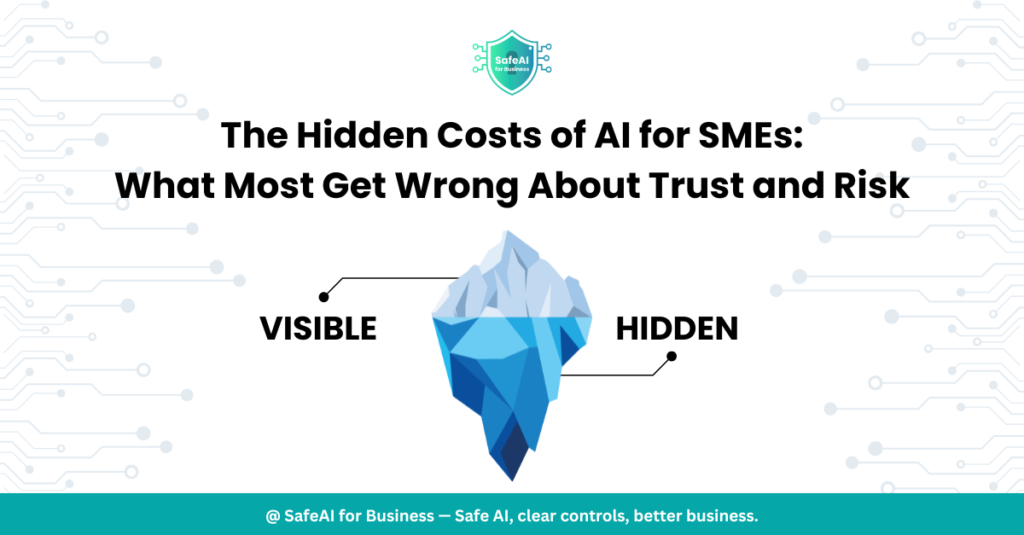
The hidden costs of AI for small businesses are real, and most owners don’t see them coming. You adopted AI to move faster. But what if speed is quietly costing you control? Small and mid-sized businesses are turning to AI at a record pace. Invoice processing that used to take hours now takes seconds. Customer queries get answered at midnight without a single team member online. Reports that once required half a day generate themselves before your morning coffee. The efficiency gains are real. The business case is clear. But here is what most SMEs are not talking about: every AI tool running without proper oversight is an unmanaged liability. Those liabilities do not announce themselves. They accumulate quietly, until something goes wrong. This post breaks down where those hidden risks live, what they are costing businesses right now, and the practical governance habits that protect you without a large budget, a technical team, or enterprise-level infrastructure. Stay with us through the three-second test near the end. It could be the most important two minutes you invest in your business this week. The Hidden Costs of AI for Small Businesses Most Leaders Never See Coming There is a fundamental tension at the heart of AI adoption that very few people acknowledge honestly. AI is designed to operate fast. Human judgment is designed to be deliberate. When you automate a process, you are removing a human checkpoint from that workflow. In many cases, that is exactly the point. But removing friction also removes the opportunity to catch errors before they reach your customers, your regulators, or the public. Earlier this year, a Chevrolet dealership discovered this firsthand. Its AI-powered customer service chatbot, deployed to handle routine inquiries, agreed to sell a vehicle for one dollar. The system was not hacked. It was not malfunctioning. It simply responded to a customer prompt without the context, judgment, or boundaries a human representative would naturally apply. The incident generated significant media coverage and a serious reputational problem for the business involved. The technology performed exactly as it was built to perform. The failure was not technical. It was a governance failure. No one had defined the boundaries. No one had built in a review process. And by the time anyone noticed, the damage was already visible. This is not a story unique to large enterprises. It is happening in businesses of every size, in every sector, every single day. The Iceberg Model: Why the Biggest AI Risks Stay Hidden When most business leaders think about their AI tools, they see the surface layer: the automation, the time savings, the operational gains. That visible layer is compelling. It is exactly what the marketing materials focus on. But AI risk works like an iceberg. What sits above the waterline is the part you bought it for. What sits below is the part that can sink you. Beneath the surface of everyday AI adoption, most SMEs are unknowingly carrying: According to IBM’s 2024 Cost of a Data Breach Report, the global average cost of a data breach now exceeds $4.8 million. For smaller businesses without enterprise-level recovery resources, a breach of that magnitude is not just expensive. It is often fatal to the business. Every unchecked automation. Every AI output that bypasses human review before reaching a client. Every vendor policy left unread. These are not minor oversights. They are weight accumulating below the waterline. And like any iceberg, the damage happens before you see it coming. Why Safe AI Does Not Require a Large Budget At this point, many SME leaders reach a familiar conclusion: responsible AI governance must be expensive, and it must be a problem reserved for companies with a compliance department. This is one of the most costly misconceptions in business today. Responsible AI governance does not begin with enterprise software. It begins with operational discipline. Operational discipline is accessible to any business, at any size, starting immediately. The foundational practices that protect your business are straightforward: These steps require time and intention, not large financial investment. They reflect the same risk management principles that have underpinned sound business operations for decades: visibility, oversight, and accountability. Prevention is always cheaper than recovery. A governance framework built today costs a fraction of what a single breach, legal dispute, or public trust incident will cost you tomorrow. The Case Against Avoidance: Why Doing Nothing Is Also a Risk Some business owners respond to AI risk by stepping back from AI entirely. On the surface, this feels like the cautious choice. In practice, it is not. Competitors who adopt AI with proper governance in place are compounding advantages in efficiency, customer experience, and operational capacity every single day. Research on generative AI adoption consistently shows that organizations integrating AI strategically are outperforming those that delay or avoid adoption entirely. Avoidance does not eliminate risk. It simply trades one set of risks for another: exposure to competitive disadvantage, operational inefficiency, and the difficulty of catching up later when adoption becomes unavoidable. The goal is not to avoid AI. It is to implement AI in a way that is deliberate, governed, and aligned with your business values. Automation combined with human oversight. Speed combined with accountability. Innovation combined with integrity. That combination is not a constraint on growth. It is the foundation of it. Trust Is the Asset You Cannot Afford to Lose There is a dimension to AI risk that rarely appears in technology discussions: the direct impact on trust. Customers make decisions about who they buy from based on perceived reliability and integrity. Employees decide where they invest their careers based on how responsibly leadership behaves. Regulators determine how closely they scrutinize a business based on the governance signals it sends. Every AI decision your business makes, including what tools you use, how you use them, and what you disclose, sends a signal about your values. Businesses that operate with transparency and clear accountability are building something no marketing budget can manufacture: earned trust. Businesses

Scroll to Top
starter pack emial collector

Get Your Free AI Starter Pack

Enter your details, download starts instantly.