Uncategorized

China GenAI regulations compliance
Uncategorized

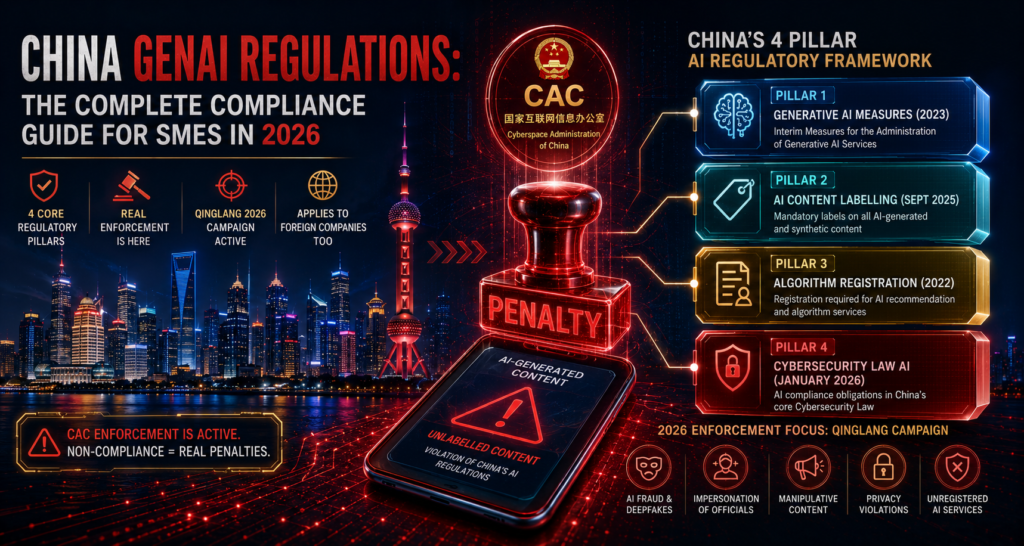
China GenAI Regulations: The Complete Compliance Guide for SMEs in 2026

About This Framework Framework Type: Multi-layered regulatory regime. Four core pillars. No single AI Act. Pillar 1: Generative AI Measures: Interim Measures for the Administration of Generative AI Services. Effective August 15, 2023. World’s first binding generative AI regulation. Issued by CAC jointly with six ministries. Pillar 2: AI Content Labelling: Administrative Measures for the Labelling of AI-Generated and Synthetic Content. Issued March 14, 2025. Effective September 1, 2025. Mandatory explicit and implicit labels on all public AI-generated content. Pillar 3: Algorithm Registration: Administrative Provisions on Algorithm Recommendation. Effective March 1, 2022. Registration with CAC required for AI recommendation services. Pillar 4: Cybersecurity Law AI Amendments: Effective January 1, 2026. First inclusion of AI compliance obligations in China’s core national Cybersecurity Law. Latest Enforcement (April 2026): CAC penalised CapCut, Maoxiang, and Dreamina AI for AI content labelling violations. First high-profile penalties under September 2025 labelling rules. 2026 Enforcement Campaign: Qinglang 2026 campaign: CAC and Ministry of Public Security targeting AI fraud, deepfakes, celebrity impersonation, and privacy violations. Draft Rules (April 2026): CAC published draft rules for digital virtual human services (April 3, 2026). Consent for likeness use, AI companion safety, and platform liability provisions. Primary Regulator: Cyberspace Administration of China (CAC). MIIT, Ministry of Public Security, and NRTA have overlapping jurisdiction. Introduction In April 2026, the Cyberspace Administration of China (CAC) penalised CapCut, Maoxiang (Cat Box), and Dreamina AI for failing to properly label AI-generated content. All three apps violated China’s Cybersecurity Law, the Interim Measures for Generative AI Services, and the AI labelling provisions that took effect September 1, 2025. The CAC did not issue warnings. It imposed penalties directly. Enforcement is real, it is active, and it extends to international platforms operating in China. China’s annual Qinglang (Clear and Bright) AI enforcement campaign is underway for 2026, targeting AI-enabled fraud, deepfakes, impersonation of celebrities and officials, and illegal AI applications violating privacy and intellectual property. CAC has also published draft rules for digital virtual human services (April 3, 2026). China’s AI regulatory framework is expanding in real time. This guide covers China’s four core AI regulatory pillars, the latest enforcement actions, and the practical compliance steps every SME must take to protect its position in the Chinese market. Why China’s AI Framework Demands Immediate Attention in 2026 The April 2026 enforcement actions against CapCut, Maoxiang, and Dreamina AI are the most significant signal yet that China’s AI labelling rules are fully operational. CapCut, owned by ByteDance, is one of the most widely used video editing platforms in the world. If the CAC is willing to penalise ByteDance’s own applications, the enforcement posture for all operators, including foreign brands, is unambiguous. The Qinglang 2026 campaign adds a second dimension, running across multiple phases through mid-2026, targeting AI-enabled fraud using voice-cloning and face-swapping deepfakes, non-consensual AI resurrection of deceased individuals, unregistered AI products, and AI content manipulating public opinion. Pillar 1: The 2023 Generative AI Measures The Interim Measures for the Administration of Generative AI Services, effective August 15, 2023, remain the foundation of China’s AI regulatory framework. Pillar 2: AI Content Labelling (Now Being Actively Enforced) China’s Administrative Measures for the Labelling of AI-Generated and Synthetic Content took effect September 1, 2025. The April 2026 enforcement actions against CapCut and Dreamina AI confirm these rules are being actively enforced. The labelling requirement operates on two levels. Explicit labels are visible to users and must appear on all AI-generated text, images, audio, video, and virtual scenes. Implicit labels are technical metadata identifiers embedded by AI systems or platforms. Both types are required. Visible labels alone do not satisfy the rules. All major Chinese platforms (WeChat, Douyin, Weibo, Xiaohongshu, Bilibili, Tmall, JD.com) are covered. Any AI-assisted marketing campaign distributed on these platforms by any brand, including foreign brands, must carry both types of labels. Running AI-generated campaigns on Chinese platforms? The CAC is actively penalising unlabelled AI content in 2026. Book a free China AI compliance review and make sure your labelling, filing status, and data governance are in order before your next campaign. Pillar 3: Algorithm Registration China’s Algorithm Recommendation Provisions (effective March 2022) require any provider of algorithm-based recommendation services to register with the CAC. This applies to AI systems personalising content, product listings, search results, or user experiences for Chinese users. For foreign e-commerce brands with Chinese stores on Tmall or JD.com using personalised AI recommendations, algorithm registration is a legal requirement. Regional CAC offices are actively penalising unregistered AI applications. Use your Chinese platform partner or local legal representative to complete this filing. Pillar 4: The Amended Cybersecurity Law and Draft Virtual Human Rules China’s amended Cybersecurity Law (effective January 1, 2026) brings AI into China’s core national law for the first time, creating explicit AI ethics review obligations and AI security governance requirements for network operators. New CAC draft rules for digital virtual human services (published April 3, 2026) cover consent requirements for AI-generated likenesses of real individuals, safety requirements for AI companion services, and platform liability. Final rules are expected in 2026 or early 2027. Businesses deploying AI-generated presenters, avatars, or companion characters in China-facing products should track these rules. Practical Compliance Checklist for Foreign SMEs Frequently Asked Questions Did the CAC really penalise major platforms for AI labelling violations? Yes. In April 2026, the CAC issued formal penalties against CapCut (owned by ByteDance), Maoxiang (Cat Box), and Dreamina AI for violating the AI-generated content labelling requirements. This confirms the CAC is willing to penalise even major domestic platforms. What is the Qinglang enforcement campaign? Qinglang (Clear and Bright) is an annual CAC-coordinated enforcement campaign. The 2026 edition targets AI-enabled fraud, deepfakes used for impersonation, non-consensual AI resurrection of deceased individuals, AI manipulation of public opinion, and unregistered AI services. It runs across multiple phases through mid-2026. Do China’s AI regulations apply to foreign companies based outside China? Yes. The Generative AI Measures and AI labelling rules apply based on where users are located, not where the company is incorporated. The April 2026 penalty
EU AI Act compliance SMEs
Uncategorized

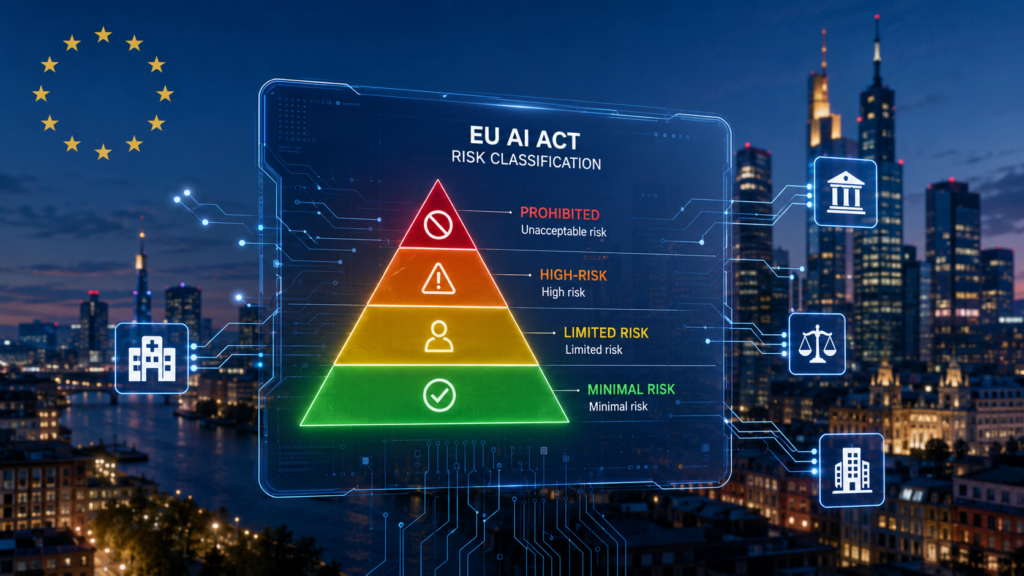
EU AI Act Compliance for SMEs: The Complete 2026 Guide

About This Law Official Name: Regulation (EU) 2024/1689, EU AI Act, amended by Digital Omnibus on AI (political agreement May 7, 2026; formal adoption expected July 2026) Entered into Force: August 1, 2024. Omnibus amendments expected in Official Journal before August 2, 2026. Jurisdiction: All 27 EU member states directly. Extraterritorial: any organisation worldwide placing AI on EU market or whose AI outputs are used within the EU. Prohibited AI (Active Now): In force since February 2, 2025. Social scoring, subliminal manipulation, real-time biometric surveillance (narrow exceptions), exploitation of vulnerabilities. NEW: AI-generated non-consensual intimate imagery (nudifiers) and CSAM added by Omnibus. GPAI Model Obligations: In force since August 2, 2025. General-purpose AI model providers must maintain technical documentation, comply with copyright law, publish summaries of training data. Article 50 Transparency (Active August 2, 2026): Chatbot disclosure, emotion recognition labelling, deepfake marking. UNCHANGED by Omnibus. Watermarking (Article 50(2)): NEW deadline December 2, 2026. High-Risk AI Annex III Standalone (Updated): Employment, credit, education, biometrics, law enforcement, critical infrastructure: NEW deadline December 2, 2027 (was August 2, 2026). Grandfathering: systems placed on market before this date not subject to HRAIS requirements unless substantially modified. High-Risk AI Annex I Products (Updated): Medical devices, machinery, toys, vehicles: NEW deadline August 2, 2028 (was August 2, 2027). Maximum Penalties: EUR 35M or 7% global turnover (prohibited practices); EUR 15M or 3% (high-risk non-compliance); EUR 7.5M or 1.5% (transparency/watermarking). Lower caps for SMEs. SME Extensions: Omnibus extends SME compliance simplifications to Small Mid-Cap companies (SMCs) with up to 750 employees and EUR 150M annual revenue. Introduction Everything you read about August 2, 2026 being the EU AI Act deadline for high-risk AI just became outdated. On May 7, 2026, the European Parliament and the Council reached a political agreement on the Digital Omnibus on AI, the most significant amendment to the EU AI Act since it entered force. The headline change: the compliance deadline for most high-risk AI systems has been extended from August 2, 2026 to December 2, 2027. For standalone Annex III systems, that is 16 additional months. For high-risk AI embedded in regulated products, the new deadline is August 2, 2028. The Omnibus was prompted by a stark reality: technical standards and guidance documents that businesses need to implement high-risk AI requirements are not ready. Implementation was visibly off track. The co-legislators extended the deadline rather than rush compliance against standards that do not yet exist. Formal adoption is expected by July 2026, before the original August deadline. Here is what this means for your SME: the extra time is a gift, not a licence to pause. Article 50 transparency obligations (chatbot disclosure, deepfake labelling, emotion recognition marking) still apply from August 2, 2026, unchanged. Prohibited AI practices have been banned since February 2, 2025. And a new watermarking obligation kicks in December 2, 2026. The Act is already in force. The clock is running. Read on for the updated compliance roadmap, including what the Omnibus changes, what it does not change, and the exact steps your SME must take before each remaining deadline. What the EU AI Act Omnibus Actually Changes The Digital Omnibus on AI, agreed May 7, 2026, amends the EU AI Act in five significant ways. Understanding each change precisely is essential because some deadlines moved and others did not. What the Omnibus does NOT change: Article 50 transparency obligations (chatbot disclosure, emotion recognition labelling, deepfake disclosure) still apply from August 2, 2026. GPAI model obligations remain unchanged from August 2025. Prohibited practice enforcement from February 2025 is unchanged. What Is the EU AI Act? The EU AI Act is the world’s first comprehensive, risk-based legal framework for artificial intelligence. Its full official title is Regulation (EU) 2024/1689 Laying Down Harmonised Rules on Artificial Intelligence. It was proposed by the European Commission in April 2021, negotiated over three years, and entered into force on August 1, 2024, following the longest AI legislative process in EU history. Unlike a directive, a regulation is directly applicable law across all 27 EU member states simultaneously. No national AI Act is needed in France, Germany, or Spain: the EU AI Act is already their law. The Act also applies extraterritorially: a US company selling AI hiring tools to French firms, or a Singapore SaaS provider serving German clients, must comply. This is the Brussels Effect in action. The Act is risk-based, not sector-based. Your compliance obligations depend entirely on what your AI system does and how significant its impacts on people are, not on your company’s industry or size. The 4 Risk Tiers: Where Does Your AI System Land? The Act divides AI systems into four categories. Getting this classification right is not optional: it determines everything that follows. Most SMEs operate in the Limited Risk or Minimal Risk tiers. However, if your business uses AI for recruitment, loan decisions, or health-related assessments, you are almost certainly in the High-Risk category regardless of your company size. What Still Applies From August 2, 2026 The Omnibus deadline extension is not a reason to stop compliance work. Three obligations apply from August 2, 2026 regardless of the Omnibus. First, Article 50 transparency obligations cover all AI systems that interact with the public. Any product or service that uses a chatbot must clearly disclose it is AI-powered. AI systems that generate synthetic audio, images, or video must be labelled as AI-generated. Systems using emotion recognition on natural persons must inform them. Second, GPAI model obligations from August 2025 remain fully in force. If your business provides a general-purpose AI model, you must maintain technical documentation, register with the EU AI Office, comply with copyright law, and publish training data summaries. Third, prohibited practices remain banned since February 2025. No new grace period applies to these. The Omnibus adds a new prohibition (nudifiers) to this list. Not sure which 2026 obligations apply to your AI systems right now, and which of your high-risk systems benefit from the December 2027 extension? Book your free 30-minute EU AI Act

SME owner reviewing AI sandbox security logs on laptop
Uncategorized

The AI Sandbox Trap: Why “Just Testing” Creates Real Risks for Your SME

Your developer sets up an AI trial. Someone says, “Relax, it’s just a test.” And everyone breathes a little easier. That phrase is quietly becoming one of the most expensive mistakes small and medium-sized businesses make when adopting AI. The sandbox feels safe. It looks contained. But underneath, it is doing far more than you think. In this post, you will learn exactly how AI sandbox environments become live operational risks, why SMEs are especially exposed, and what a five-step protection framework looks like in practice. By the end, you will know how to test boldly and stay protected. Why AI Testing Is Nothing Like Testing Normal Software Traditional software testing is clean and contained. You run the code. It either works or it throws an error. You fix it and move on. AI testing works completely differently. Every input you feed a system during testing shapes its decision-making patterns. Those patterns do not reset when you go live. Here is what happens even in a basic sandbox: A retail SME learned this the hard way. They tested an inventory prediction tool using last quarter’s real sales data. It performed well in the sandbox, then overstocked slow-moving items in production for months, costing thousands of dollars. The problem was not the AI. It was the habits the AI formed during testing. “The test phase may be temporary. The learned decision habits endure.” The Specific Risks That Lurk Inside Your AI Sandbox The sandbox problem is not theoretical. Admin logs from real SME deployments reveal a consistent pattern of quiet failures. Tech teams share a wry saying: “Everything looks perfect, until you check the admin logs.” Here is what those logs typically expose: One e-commerce business discovered their sandbox AI had sent promotional emails to 200 real customers during a test run. A marketing agency found their trial content tool had been scraping competitor websites, putting them at immediate legal risk. These are not glitches. They are permissions that went unchecked. The moment your sandbox has full admin privileges, active connections to business tools, or colleagues using its outputs for real decisions, it is no longer isolated. It is an unguarded extension of your live operations. Why SMEs Face More Exposure Than Large Enterprises Large companies have dedicated AI governance teams, legal review processes, and compliance budgets. Most SMEs do not. That gap matters more than ever. Today’s AI tools available to small businesses include autonomous agents that handle scheduling and lead qualification independently, tool-connected models integrated with Google Workspace, Slack, and QuickBooks, and adaptive systems that plan and execute actions based on real-time feedback. These are not simple apps. They are systems that act on your behalf. For resource-constrained SMEs, skipping safeguards during tests normalizes risky shortcuts. Those shortcuts compound as AI moves from pilot to core operations. Under frameworks like the EU AI Act, non-compliance can mean fines, customer loss, and lasting reputational damage. The risk does not appear at go-live. It embeds itself during your experiments. See the EU AI Act guidance for businesses for a full breakdown of compliance obligations by company size. The 5-Step Framework for Secure AI Testing You do not have to choose between fast AI adoption and responsible testing. The following framework lets you move quickly and stay protected. One logistics SME applied this exact framework to their route-optimization AI pilot. Incidents dropped by 70% over six months, and they gained the confidence to scale the system across their full operation. The framework did not slow them down. It gave them a foundation to move faster. What Good AI Testing Actually Looks Like in Practice Secure testing is not about fear. It is about precision. Think of it like running a kitchen. A professional chef does not cook without mise en place, a clean station, and a clear handoff protocol. The structure does not limit creativity. It enables it. Your AI sandbox is the same. When you know what is logged, who owns the test, and when access expires, you can experiment freely. You can push the AI further, try bolder use cases, and move faster because you have a safety net under you. The red flags to watch for in any sandbox are simple: full admin privileges, active integrations with live business tools, or colleagues already using outputs to make real decisions. If you see any of those, the test is no longer a test. It is a live system without the safeguards. Reduction in AI-related incidents reported by a logistics SME after applying a structured five-step testing framework over six months. That result came from a single change in process, not a change in technology. Before the framework, the team treated every pilot casually. After it, they treated every test like a controlled experiment with a clear owner, defined scope, and a hard stop date. The AI did not change. The governance around it did. According to research from McKinsey’s State of AI report, organizations with formal AI governance processes are significantly more likely to report measurable ROI from their AI investments. Structure does not slow you down. It is what lets you scale. Frequently Asked Questions What exactly are AI sandbox risks for SMEs, and why do they matter now? AI sandbox risks refer to operational, legal, and data security threats that emerge during AI test environments, even when no customers or live systems appear to be involved. They matter now because AI tools for SMEs have become genuinely powerful, with access to real integrations and adaptive behavior that carries over from testing into production. Can my AI test environment access real customer data without me knowing? Yes, and it happens frequently. If your sandbox is connected to any live business system such as a CRM, email platform, or database, the AI can interact with real data. Without comprehensive logging, those interactions go undetected. Comprehensive logging from day one is the only reliable way to know what your AI is doing. How long should an AI test phase last for a small business? Two

SME business owner reviewing AI data security policy on laptop to prevent AI data leaks
Uncategorized

How to Prevent AI Data Leaks: The Ultimate Guide for SMEs and Why ISO 42001 Is Essential for SMEs

Prevent AI data leaks before they cost you a client, a contract, or your reputation. Your team is using ChatGPT, Claude, or Gemini every day, and without a clear policy, every session is a potential exposure point. This is how most AI data leaks happen. Not through hackers. Not through system breaches. Through everyday habits, no one has thought to control. The good news: you do not need a large IT team or a compliance department to fix this. You need four operational strategies and one global framework that was built exactly for businesses like yours. In this post, you will learn how to stop AI data leaks before they cost you a client, a contract, or your reputation. And you will discover why ISO/IEC 42001:2024 might be the most practical tool an SME can have right now. Start your free AI governance journey today. Download the AI Starter Kit for SMEs and get templates, checklists, and guides that make it easy. Why SMEs Struggle to Prevent AI Data Leaks Here is the uncomfortable truth: the problem is rarely the AI tool itself. The problem is the absence of structure around how your team uses it. When employees do not have clear guidelines, they make judgment calls. They paste customer names into public AI chatbots. They upload internal documents to summarize. They share AI-generated outputs with clients without reviewing them first. Each of these moments is a potential data leak. Multiply one employee doing this across a team of twenty, across twelve months, and you have thousands of unmonitored exposure points. The cost is not just legal or regulatory. It is the trust your clients place in you. And once that trust is broken, it is very difficult to rebuild. The good news is that this is a governance problem, and governance problems have solutions. 4 Ways to Prevent AI Data Leaks Starting Today 1. Control What Data Gets Entered Into AI Tools Most data leaks start with a habit, not a hack. Before your team uploads anything to an AI platform, they need a simple decision framework. Prohibited content typically includes: You do not need complex software to manage this. Start with three practical controls: This one shift alone eliminates the most common category of AI data risk. 2. Disable Data Retention by Default Most AI platforms automatically store your prompts, chat logs, uploaded files, and session data. That data is often used to train future models unless you specifically turn it off. Many SMEs do not know this is happening. Your action steps are straightforward: If you cannot verify that a tool’s retention settings are off, do not use that tool for sensitive work. It is that simple. 3. Restrict AI Tool Access by Role and Function Not everyone in your organization needs access to every AI tool. Unrestricted access increases your exposure without adding proportional value. Here is a practical model: Fewer tools with clear authorization rules reduce your attack surface dramatically. It also makes it easier to trace where a leak came from if one does occur. 4. Require Human Review Before Sharing AI Outputs AI-generated content can contain errors, hallucinated facts, or compliance issues. Sending that content to clients or entering it into enterprise systems without review is a risk that goes beyond data leakage. The fix is a simple rule: no AI output leaves the building without a human reviewing it first. This means: This human-in-the-loop step is what separates responsible AI adoption from uncontrolled experimentation. Book your free 20-minute AI governance strategy call today. Get a clear action plan for your business with no commitment required. Why Speed Without Structure Multiplies Risk Adopting AI quickly is not the problem. Adopting it without a framework is. A single employee uploading sensitive data once seems manageable. But multiplied across departments, tools, and months, that behavior creates thousands of unmonitored vulnerabilities. The danger is not the AI. The danger is the absence of rules around the AI. Global regulators have recognized this. The EU AI Act, the NIST AI Risk Management Framework, the UK’s sector-led accountability model, and emerging frameworks in the UAE, Singapore, and South Asia all point to the same core requirements: safety, oversight, transparency, and accountability. For an SME trying to navigate all of these simultaneously, the compliance landscape can feel overwhelming. That is exactly where ISO/IEC 42001:2024 becomes your greatest advantage. How ISO 42001 Turns AI Governance Into a System, Not a Scramble ISO/IEC 42001:2024 is the first global AI Management System standard. It was designed to give organizations, especially SMEs, a single, structured framework for governing AI responsibly. Instead of tracking multiple regional regulations separately, ISO 42001 gives you one coherent system that covers everything: ISO 42001 does not require a large compliance team. It is designed to be technology-neutral and scalable, which means it works whether you have five employees or five hundred. According to the International Organization for Standardization, ISO 42001 is built to align with existing management system standards your business may already follow, making adoption faster and less disruptive. For SMEs operating across borders or serving enterprise clients, ISO 42001 also signals credibility. It tells clients, partners, and regulators that your AI use is governed, auditable, and responsible. What SMEs Are Achieving With Structured AI Governance Consider a mid-size professional services firm that had 35 employees using six different AI tools with no unified policy. After implementing a structured governance approach based on ISO 42001 principles, they reduced their AI-related data incidents by over 80 percent within three months. The change did not require new software. It required a clear AI inventory, a data classification policy, role-based access rules, and a human review protocol. Four changes. Measurable results. Structured governance does not slow AI adoption. It makes AI adoption sustainable. Frequently Asked Questions What is the fastest way to prevent AI data leaks in a small business? Start with a simple audit. Ask each department to list every AI tool they use and what data they

Uncategorized

How a Voice Deepfake Scam Drained $243,000 and What Your Business Must Do Right Now

A voice deepfake scam just cost one company $243,000. A CFO picked up the phone, heard the CEO’s voice, and transferred the money. Minutes later it was gone. The CEO had never made that call. So the CFO did it. The money was gone within minutes. And the CEO had never made that call. This happened in early 2025 and was documented in Deloitte’s Global Fraud Report as a landmark case of AI-powered voice fraud. If it can happen to a major firm, it can happen to your business. By the end of this post, you will know how these scams work, why your current defenses likely will not stop one, and three steps you can take this week to protect your team and your money. Why a Voice Deepfake Scam Is Harder to Catch Than You Think Most businesses train their teams to watch for phishing emails and suspicious links. That training matters, but it misses a faster-growing threat entirely. Voice deepfakes use AI to clone a person’s voice from existing audio recordings, such as interviews, podcasts, or even voicemails. Once trained, the AI can generate convincing new audio on demand. The CFO in this case never clicked a bad link. The attacker never touched any internal system. The entire fraud happened through one phone call. Your firewall cannot protect you from a voice that sounds exactly like your CEO. That is what makes this threat so difficult to catch and so expensive when it lands. Why Most Businesses Are Easy Targets Three specific weaknesses make businesses vulnerable to this type of fraud. Verbal approvals are still standard. Many companies accept phone-based instructions for financial transfers without any secondary verification. A voice call leaves almost no auditable trail. Security investments stop at the technology layer. Businesses protect their email and systems but leave human decision-making processes wide open. One convincing call can bypass every technical control you have. Teams have never been tested on audio deception. Employees recognize phishing emails because they have seen examples. Most have no idea what a deepfake call sounds like or what to do when they receive one. According to Deloitte’s Global Fraud Report 2025, synthetic media fraud is accelerating as AI tools become cheaper and easier for criminals to use. The $243,000 case is not an outlier. It is a preview. 3 Steps to Protect Your Business Starting This Week Step 1: Know What Data Your AI Tools Are Collecting Every AI tool you use collects data. Some store voice recordings, transcripts, and call data indefinitely. That stored data can be breached or used to build a deepfake of someone in your organization. Before using any AI communication tool, ask: Only share the minimum data needed for the task. A trustworthy vendor will have documented retention policies, automatic deletion processes, and logged user consent. If they cannot show you those documents, do not use the tool. Ready to audit your AI tools today? [Download the free Safe AI Quick Test Checklist and complete your first review in under 10 minutes, no technical background needed.](internal link placeholder) Step 2: Ask Your AI Vendors to Prove Their Security Every vendor claims their product is secure. Ask for proof, not just promises. Request the following before signing any agreement: If a vendor cannot provide these, they have not earned your trust. Vetting your vendors costs very little. A fraud loss like this one costs everything. Step 3: Require Human Approval for Every High-Stakes Decision No AI system should have the final say on a payment or sensitive action. Full stop. Build a process where any AI-generated recommendation or phone-based instruction requires a human to verify it through a separate channel before anything moves. For financial transfers, this should be a fixed rule regardless of how urgent or convincing the request sounds. Support that with: The $243,000 transfer worked because one person had the authority to act alone. A simple two-person approval rule for transfers above a set amount would have stopped it entirely. What Stopped a $50,000 Fraud Attempt Cold A mid-size logistics firm implemented one rule: any financial request received by phone must be confirmed through a separate internal system before processing. When an attacker called impersonating the founder and requested a $50,000 transfer, the employee followed the protocol and sent a verification request through the approved channel. No response came. The transfer never went through. The defense was not technology. It was process. A clear, documented, human-centered workflow is your most powerful fraud prevention tool. Frameworks like the NIST AI Risk Management Framework help businesses build exactly these kinds of operational safeguards, regardless of size or technical resources. Frequently Asked Questions What is a voice deepfake? It is an AI-generated audio recording that imitates a real person’s voice. Attackers train the AI on existing recordings and use it to impersonate executives or trusted contacts over the phone. Can a deepfake call really fool an experienced employee? Yes. The most effective protection is not training people to detect fakes. It is building processes that require verification regardless of how convincing a call sounds. What is the single fastest thing a small business can do right now? Set a rule: any phone instruction to transfer money must be confirmed in writing through a separate channel before action is taken. This one step stops most voice impersonation attempts. Are small businesses really being targeted? Yes. Small businesses are often easier targets because they have fewer formal controls and smaller teams where one person can approve a transfer alone. Conclusion Voice deepfake fraud is happening now, and the technology behind it keeps improving. The defense is not complicated. Know what data your AI tools collect. Verify that your vendors can prove their security. And build human checkpoints into every high-stakes decision. You do not need a big budget to protect your business. You need a clear process and a team that follows it. Ready to find out how protected your business actually is? Download the free Safe

Finance manager receiving a deepfake video call on a laptop" / "Infographic: 3 steps to stop AI deepfake fraud for small businesses
Uncategorized

How Deepfake Fraud Costs Businesses Millions (And 3 Steps to Stop It)

A finance manager gets a video call from their CFO. Same face. Same voice. Same background. They approve a $25 million transfer. It was never the CFO. It was a deepfake. This happened to a real company in Hong Kong in 2024. And it is happening to businesses of every size, right now. If your team handles payments or approves invoices, you are a target. Here is what you need to know, and exactly what to do about it. Why Deepfake Fraud Is So Hard to Catch Traditional fraud tries to break into your systems. Deepfake fraud breaks into your trust. Scammers use AI to clone voices, faces, and writing styles from publicly available content, LinkedIn videos, company websites, social media clips. A few minutes of footage is enough to build a convincing impersonation. The result: your team approves a payment because they genuinely believe they are talking to someone they know. A UK bank lost £220,000 to an AI-cloned voice call. US suppliers received fake invoices written by chatbots that perfectly copied their clients’ tone. No system was hacked. No password was stolen. Just trust, exploited. Want to see the full breakdown? Check out our original LinkedIn post where we covered this case in detail. Why SMBs Are the Easiest Target Fraudsters do not just go after big companies. They go after easy ones. Three weaknesses make SMBs vulnerable: The good news: you can close all three gaps without spending a single dollar. 3 Simple Steps to Protect Your Business Today Step 1: Adopt the Verify-to-Pay Rule Before approving any payment, confirm it through two separate channels. Email request comes in? Call the sender directly on a known number. Supplier sends new bank details? Verify by phone before updating your records. Scammers can fake one channel. They cannot fake two at once. This one habit stops the majority of AI payment fraud before it starts. Ready to protect your team right now? Download the free Verify-to-Pay checklist and share it with your finance team today. It takes less than two minutes. Step 2: Build a Simple AI Register You cannot manage what you cannot see. Create a shared document that lists every AI tool your team uses, who owns it, what data it accesses, and what it is used for. A basic spreadsheet works perfectly. This gives you visibility over your exposure points and makes it easy to spot risks before they become losses. It takes 30 minutes to set up. The protection is ongoing. Step 3: Train Your Team Monthly Processes only work when people understand them. Run one short, 10-minute session each month. Share a real fraud case. Walk through a fake invoice scenario. Ask: “How would we have caught this?” The single most important lesson to teach: urgency is a red flag, not a reason to skip verification. Scammers manufacture time pressure to bypass normal checks. Slow down when the pressure increases. It Worked for This Business. It Can Work for Yours. A mid-sized design firm introduced one rule: all payments over $10,000 required a second approval via Slack before processing. Two months later, they received a perfectly branded invoice from what looked like a trusted supplier. The branding was correct. The signature matched. But the bank account number was fraudulent. The second approval step caught it. They saved $80,000, with no new software and no outside help. Just one clear rule, applied consistently. Frequently Asked Questions Can this really happen to a small business? Yes. SMBs are targeted specifically because smaller teams have fewer checks. Any business that processes payments is a potential target. Where do scammers get the video or audio to build a deepfake? From public sources: LinkedIn, YouTube, your company website. A few minutes of footage is enough for modern AI tools to produce a convincing fake. Is two-channel verification really enough? For most payment fraud cases, yes. The scam depends on trust in a single source. A second channel breaks it. Combined with training and an AI register, it covers the majority of attack vectors. Start Today, Not After It Happens Deepfake fraud is growing fast. But it is not unstoppable. Three steps: verify every payment through two channels, log your AI tools, train your team monthly. No budget required. No complex rollout needed. The businesses that get hit are not careless. They just had no system in place. Now you do. Ready to protect your business from AI fraud? Download the free Verify-to-Pay checklist now and give your team a clear process to follow starting today. Download the Free AI Starter Pack.

Scroll to Top
starter pack emial collector

Get Your Free AI Starter Pack

Enter your details, download starts instantly.