About This Framework
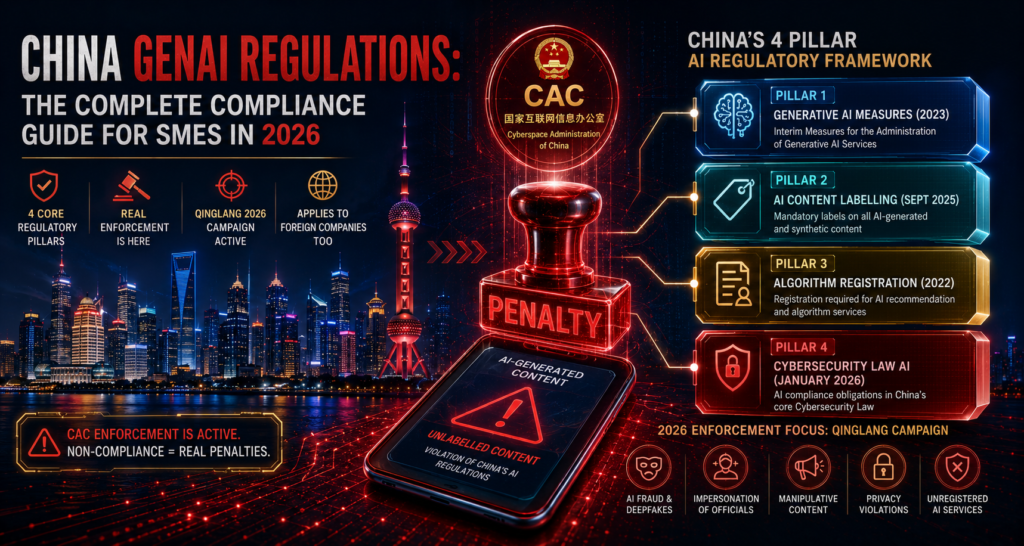
Framework Type: Multi-layered regulatory regime. Four core pillars. No single AI Act.
Pillar 1: Generative AI Measures: Interim Measures for the Administration of Generative AI Services. Effective August 15, 2023. World’s first binding generative AI regulation. Issued by CAC jointly with six ministries.
Pillar 2: AI Content Labelling: Administrative Measures for the Labelling of AI-Generated and Synthetic Content. Issued March 14, 2025. Effective September 1, 2025. Mandatory explicit and implicit labels on all public AI-generated content.
Pillar 3: Algorithm Registration: Administrative Provisions on Algorithm Recommendation. Effective March 1, 2022. Registration with CAC required for AI recommendation services.
Pillar 4: Cybersecurity Law AI Amendments: Effective January 1, 2026. First inclusion of AI compliance obligations in China’s core national Cybersecurity Law.
Latest Enforcement (April 2026): CAC penalised CapCut, Maoxiang, and Dreamina AI for AI content labelling violations. First high-profile penalties under September 2025 labelling rules.
2026 Enforcement Campaign: Qinglang 2026 campaign: CAC and Ministry of Public Security targeting AI fraud, deepfakes, celebrity impersonation, and privacy violations.
Draft Rules (April 2026): CAC published draft rules for digital virtual human services (April 3, 2026). Consent for likeness use, AI companion safety, and platform liability provisions.
Primary Regulator: Cyberspace Administration of China (CAC). MIIT, Ministry of Public Security, and NRTA have overlapping jurisdiction.
Introduction
In April 2026, the Cyberspace Administration of China (CAC) penalised CapCut, Maoxiang (Cat Box), and Dreamina AI for failing to properly label AI-generated content. All three apps violated China’s Cybersecurity Law, the Interim Measures for Generative AI Services, and the AI labelling provisions that took effect September 1, 2025. The CAC did not issue warnings. It imposed penalties directly. Enforcement is real, it is active, and it extends to international platforms operating in China.
China’s annual Qinglang (Clear and Bright) AI enforcement campaign is underway for 2026, targeting AI-enabled fraud, deepfakes, impersonation of celebrities and officials, and illegal AI applications violating privacy and intellectual property. CAC has also published draft rules for digital virtual human services (April 3, 2026). China’s AI regulatory framework is expanding in real time.
This guide covers China’s four core AI regulatory pillars, the latest enforcement actions, and the practical compliance steps every SME must take to protect its position in the Chinese market.
Why China’s AI Framework Demands Immediate Attention in 2026
The April 2026 enforcement actions against CapCut, Maoxiang, and Dreamina AI are the most significant signal yet that China’s AI labelling rules are fully operational. CapCut, owned by ByteDance, is one of the most widely used video editing platforms in the world. If the CAC is willing to penalise ByteDance’s own applications, the enforcement posture for all operators, including foreign brands, is unambiguous.
The Qinglang 2026 campaign adds a second dimension, running across multiple phases through mid-2026, targeting AI-enabled fraud using voice-cloning and face-swapping deepfakes, non-consensual AI resurrection of deceased individuals, unregistered AI products, and AI content manipulating public opinion.
Pillar 1: The 2023 Generative AI Measures
The Interim Measures for the Administration of Generative AI Services, effective August 15, 2023, remain the foundation of China’s AI regulatory framework.
- Scope: Applies to generative AI services provided to the general public within China. AI developed and used internally by enterprises (not public-facing) is exempt. AI services targeting only users outside China are also exempt.
- Service registration and filing: Services with public opinion attributes or social mobilisation capabilities must conduct a CAC security assessment and file their large language model before launch.
- Content governance: Mandatory content moderation to prevent illegal content, disinformation, and IP violations.
- Training data quality: Measures to prevent discrimination based on ethnicity, gender, age, and occupation in training data.
- User rights: Clear AI service information, complaint mechanisms, and right-to-correction processes.
Pillar 2: AI Content Labelling (Now Being Actively Enforced)
China’s Administrative Measures for the Labelling of AI-Generated and Synthetic Content took effect September 1, 2025. The April 2026 enforcement actions against CapCut and Dreamina AI confirm these rules are being actively enforced.
The labelling requirement operates on two levels. Explicit labels are visible to users and must appear on all AI-generated text, images, audio, video, and virtual scenes. Implicit labels are technical metadata identifiers embedded by AI systems or platforms. Both types are required. Visible labels alone do not satisfy the rules.
All major Chinese platforms (WeChat, Douyin, Weibo, Xiaohongshu, Bilibili, Tmall, JD.com) are covered. Any AI-assisted marketing campaign distributed on these platforms by any brand, including foreign brands, must carry both types of labels.
Running AI-generated campaigns on Chinese platforms? The CAC is actively penalising unlabelled AI content in 2026. Book a free China AI compliance review and make sure your labelling, filing status, and data governance are in order before your next campaign.
Pillar 3: Algorithm Registration
China’s Algorithm Recommendation Provisions (effective March 2022) require any provider of algorithm-based recommendation services to register with the CAC. This applies to AI systems personalising content, product listings, search results, or user experiences for Chinese users.
For foreign e-commerce brands with Chinese stores on Tmall or JD.com using personalised AI recommendations, algorithm registration is a legal requirement. Regional CAC offices are actively penalising unregistered AI applications. Use your Chinese platform partner or local legal representative to complete this filing.
Pillar 4: The Amended Cybersecurity Law and Draft Virtual Human Rules
China’s amended Cybersecurity Law (effective January 1, 2026) brings AI into China’s core national law for the first time, creating explicit AI ethics review obligations and AI security governance requirements for network operators.
New CAC draft rules for digital virtual human services (published April 3, 2026) cover consent requirements for AI-generated likenesses of real individuals, safety requirements for AI companion services, and platform liability. Final rules are expected in 2026 or early 2027. Businesses deploying AI-generated presenters, avatars, or companion characters in China-facing products should track these rules.
Practical Compliance Checklist for Foreign SMEs
- Audit all AI-generated content in your China marketing immediately: Every piece of AI-assisted content on WeChat, Douyin, Weibo, or any other Chinese platform requires both explicit (visible) and implicit (metadata) labels.
- Check CAC security assessment and filing status: If your AI service is publicly accessible in China and generates or recommends content that could influence public opinion, a security assessment and filing is required before launch.
- Register any recommendation algorithm: If you personalise content or products for Chinese users using AI, register the algorithm with the CAC through your Chinese platform partner.
- Monitor the virtual human draft rules: If you use AI-generated presenters, avatars, brand characters, or companion AI in Chinese-market products, track the CAC draft virtual human service rules.
- Review your data governance under PIPL: China’s Personal Information Protection Law applies to all personal data of Chinese citizens used in or generated by AI systems.
Frequently Asked Questions
Did the CAC really penalise major platforms for AI labelling violations?
Yes. In April 2026, the CAC issued formal penalties against CapCut (owned by ByteDance), Maoxiang (Cat Box), and Dreamina AI for violating the AI-generated content labelling requirements. This confirms the CAC is willing to penalise even major domestic platforms.
What is the Qinglang enforcement campaign?
Qinglang (Clear and Bright) is an annual CAC-coordinated enforcement campaign. The 2026 edition targets AI-enabled fraud, deepfakes used for impersonation, non-consensual AI resurrection of deceased individuals, AI manipulation of public opinion, and unregistered AI services. It runs across multiple phases through mid-2026.
Do China’s AI regulations apply to foreign companies based outside China?
Yes. The Generative AI Measures and AI labelling rules apply based on where users are located, not where the company is incorporated. The April 2026 penalty actions demonstrate that this scope is enforced in practice.
What are the draft virtual human rules about?
CAC published draft rules for digital virtual human services on April 3, 2026. They cover consent requirements for AI-generated likenesses of real people, safety requirements for AI companion services, and platform liability. Final rules are expected in 2026 or early 2027.
Conclusion
China’s AI regulatory framework is the most actively enforced as of April 2026. The CapCut and Dreamina AI penalties, the Qinglang 2026 campaign, and the draft virtual human rules all point in the same direction: the CAC is enforcing existing rules and building new ones simultaneously.
For foreign SMEs, the compliance priorities are clear: audit your AI-generated content for labelling compliance immediately, check your CAC filing status, and monitor the virtual human draft rules.
Ready to protect your Chinese market position? Book your free China AI compliance review today. We will audit your AI-generated content, verify your CAC filing status, and give you a clear action plan that reflects the latest April 2026 enforcement landscape.