South Korea AI Basic Act: What Foreign Companies Must Know in 2026
About This Law Official Name: Act on the Development of Artificial Intelligence and the Establishment of a Foundation for Trust (AI Basic Act / AI Framework Act), Act No. 20676 Passed by National Assembly: December 26, 2024 Promulgated: January 21, 2025 Enforcement Decree Effective: January 22, 2026

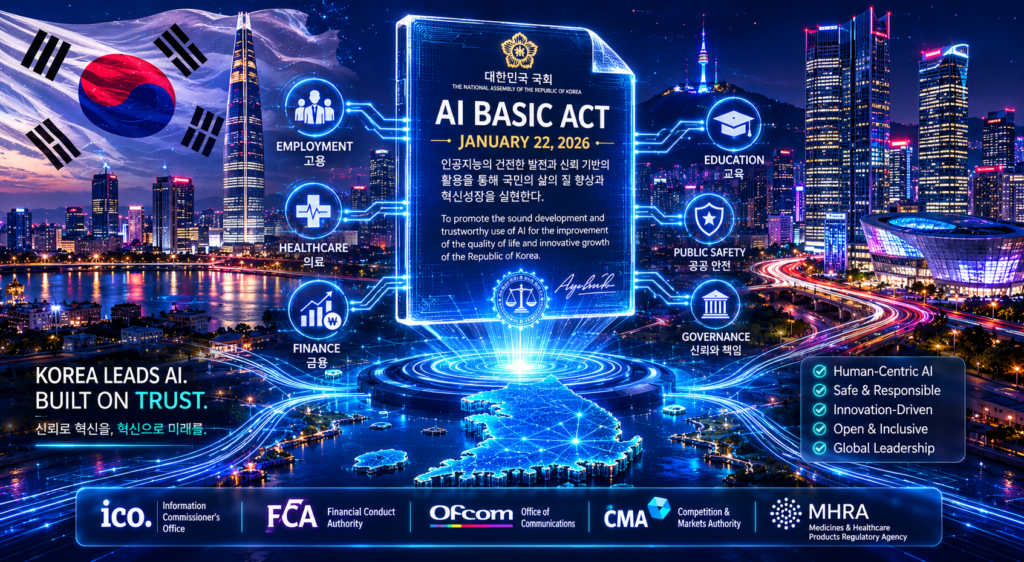
About This Law
Official Name: Act on the Development of Artificial Intelligence and the Establishment of a Foundation for Trust (AI Basic Act / AI Framework Act), Act No. 20676
Passed by National Assembly: December 26, 2024
Promulgated: January 21, 2025
Enforcement Decree Effective: January 22, 2026 (Presidential Decree No. 36053)
Jurisdiction: Republic of Korea. Extraterritorial: applies to any foreign business whose AI activities affect Korean market users.
Grace Period: At least one year from January 22, 2026. Fines deferred except for exceptional cases involving serious social harm (loss of life or human rights violations).
High-Performance AI Threshold: AI systems trained with cumulative compute of at least 10^26 FLOPs. Roughly 10 times EU AI Act GPAI threshold. Primarily targets global big-tech GPAI operators.
High-Impact AI Categories: Employment, healthcare, financial services, public safety, education. Mandatory lifecycle risk management, impact assessments, and compliance reporting.
Generative AI Obligation: Any business producing AI-generated content visible to Korean users must notify users in advance and label outputs that may be difficult to distinguish from non-AI content.
Governing Ministry: Ministry of Science and ICT (MSIT). National AI Committee (under President). AI Safety Research Institute.
Implementation Task Force: AI Basic Act Institutional Improvement Task Force launched March 2026. 40+ experts across industry, academia, civil society. Refining implementation during grace period.
Introduction
On January 21, 2025, South Korea became the second jurisdiction in the world, after the European Union, to enact comprehensive AI legislation. The Act on the Development of Artificial Intelligence and the Establishment of a Foundation for Trust (Act No. 20676), known as the AI Basic Act or AI Framework Act, was passed by the National Assembly on December 26, 2024, promulgated on January 21, 2025, and took full legal effect on January 22, 2026.
Since the Act took effect, MSIT has clarified several key compliance details. The high-performance AI threshold has been confirmed at systems trained with a cumulative compute of at least 10 to the power of 26 floating-point operations (FLOPs), roughly ten times the EU AI Act’s general-purpose AI model threshold. A multi-stakeholder AI Basic Act Institutional Improvement Task Force of more than 40 experts launched in March 2026 to refine implementation during the one-year grace period.
This guide breaks down who the Act applies to, the clarified compliance details, and the practical steps foreign SMEs must take before the grace period ends and enforcement fines begin.
Why South Korea’s AI Law Is a Landmark Moment for Asia-Pacific
Before the AI Basic Act, South Korea had more than 20 separate AI governance bills circulating through the National Assembly. The Act consolidated them into a single unified framework, balancing industrial promotion with safety, transparency, and human rights protection. It is the world’s first comprehensive AI law in the Asia-Pacific region and only the second globally after the EU AI Act.
New President Lee Jae-myung has publicly defined AI as a game-changer that will shift the global economic paradigm, presenting it as a core engine for South Korea’s technology-led growth. The government is pairing regulation with significant AI investment: startup support programmes, government-funded training data access, and AI Growth Zones with reduced regulatory requirements.
Does the South Korea AI Basic Act Apply to Your Company?
The Act applies to both domestic and foreign AI business operators. The foreign company domestic representative requirement is triggered when a company meets any one of three thresholds.
- Previous year’s revenue of KRW 1 trillion (approximately USD 681 million) or more.
- AI service segment revenue in Korea of KRW 10 billion (approximately USD 6.9 million) or more.
- Average daily Korean users exceeding 1 million over the preceding 3 months.
For most SMEs, these thresholds mean the domestic representative requirement does not immediately apply. However, High-Impact AI requirements and the generative AI user notification obligation apply to any business operating in Korea regardless of size.
High-Impact AI: The Core Compliance Category
High-Impact AI is the Act’s central compliance concept: AI systems that may significantly affect human life, safety, or fundamental rights.
- Employment-related AI: Resume screening, candidate ranking, performance evaluation, promotion decisions, and automated disciplinary systems qualify if they affect Korean employees or applicants.
- Healthcare AI: Diagnostic systems, treatment recommendation tools, and patient risk assessment AI.
- Financial services AI: Credit scoring, loan decisions, insurance underwriting, and investment recommendation systems.
- Public safety AI: Law enforcement, emergency response, and critical infrastructure management.
- Educational AI: Systems that evaluate, grade, or determine student access to educational opportunities.
For High-Impact AI, operators must implement lifecycle risk identification and mitigation, maintain incident monitoring systems, conduct fundamental rights impact assessments before deployment, and report compliance information to MSIT.
Operating an AI system in South Korea that may qualify as High-Impact AI, or using generative AI that produces content for Korean users? Book a free compliance assessment. Our team reviews your AI use cases against the Act’s definitions and tells you exactly what obligations apply.
The High-Performance AI Threshold: 10 to the Power of 26 FLOPs
MSIT confirmed in the Enforcement Decree that AI systems trained with a cumulative compute of at least 10 to the power of 26 floating-point operations (FLOPs) are designated as high-performance AI and subject to additional safety obligations.
This threshold is roughly ten times higher than the EU AI Act’s GPAI model computation threshold. This was a deliberate policy choice targeting only the most powerful global AI systems, primarily from US and Chinese big tech companies, while exempting the vast majority of commercially deployed AI. Most SMEs are well below this threshold.
The Domestic Representative Requirement Explained
Foreign AI business operators that meet the revenue or user thresholds must designate a domestic representative in South Korea and report that designation to MSIT. The representative bears legal accountability for the company’s compliance and must have a domestic Korean address or place of business.
The April 2025 amendment to Korea’s PIPA tightened these rules, requiring companies with established Korean business units to designate those units rather than unrelated third-party nominees.
Frequently Asked Questions
When did the South Korea AI Basic Act take effect?
The Act and its Enforcement Decree both took effect on January 22, 2026. A one-year grace period applies to administrative fines, with exceptions for exceptional cases involving serious social harm. Substantive compliance obligations apply from January 22, 2026.
What is the high-performance AI FLOPs threshold and does it affect my business?
MSIT confirmed the threshold at 10^26 FLOPs of cumulative compute. This primarily affects global frontier AI model developers such as OpenAI, Google, and Anthropic. Most SMEs and mid-size AI companies are well below this threshold.
Does the AI Basic Act apply to internal AI tools used by a Korean subsidiary?
Yes, if those tools make decisions affecting Korean employees. HR AI systems, performance evaluation tools, and recruitment algorithms used within a Korean office fall under the High-Impact AI employment category, regardless of where the system was built or hosted.
How does the AI Basic Act interact with South Korea’s PIPA data protection law?
PIPA remains fully applicable alongside the AI Basic Act. AI systems processing personal data of Korean residents must comply with PIPA’s consent, security, minimisation, and data subject rights requirements in addition to the AI Basic Act obligations.
Conclusion
South Korea’s AI Basic Act is in force, its key compliance details have been clarified, and its grace period on fines is running. The high-performance AI threshold at 10^26 FLOPs applies primarily to global frontier AI operators. But the High-Impact AI obligations and the generative AI labelling requirements apply to any business whose AI systems affect Korean users, regardless of size.
Serving Korean users with AI, or employing Korean workers with AI systems? Book your free South Korea AI compliance assessment today. We will identify your specific obligations under the Act, advise on the representative requirement, and give you a clear action plan before fines begin.